Politics
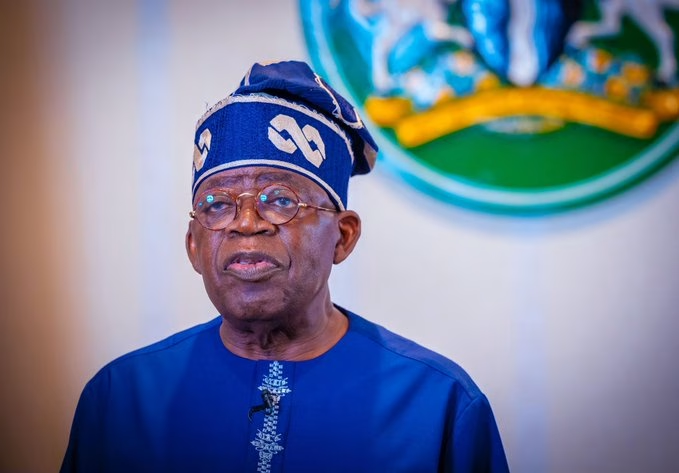
Breaking: Tinubu Ends State of Emergency in Rivers State [Full Speech]
President Tinubu ends six-month state of emergency in Rivers State, clears Governor Fubara, Deputy Odu, and lawmakers to resume duties September 18.

President Bola Ahmed Tinubu has announced the end of the state of emergency in Rivers State, six months after it was imposed over a political crisis.
In a national address on Tuesday, Tinubu said the measure, declared on March 18, 2025, was necessary to halt a “total paralysis of governance” following the breakdown of relations between Governor Siminalayi Fubara and the State House of Assembly.
The President confirmed that the emergency will expire at midnight today, allowing Governor Fubara, Deputy Governor Ngozi Nma Odu, Speaker Martins Amaewhule, and lawmakers to resume their duties on September 18.
Tinubu urged political leaders across the country to prioritize peace and cooperation, warning that democracy cannot thrive in an atmosphere of “violence, anarchy, and insecurity.”
Read Full Speech
STATEMENT BY HIS EXCELLENCY, BOLA AHMED TINUBU, PRESIDENT OF THE FEDERAL REPUBLIC OF NIGERIA, ON THE CESSATION OF THE STATE OF EMERGENCY IN RIVERS STATE
My Fellow countrymen and, in particular, the good people of Rivers State.
I am happy to address you today on the state of emergency declaration in Rivers State. You will recall that on 18th March, 2025, I proclaimed a state of emergency in the state. In my proclamation address, I highlighted the reasons for the declaration. The summary of it for context is that there was a total paralysis of governance in Rivers State, which had led to the Governor of Rivers State and the House of Assembly being unable to work together. Critical economic assets of the State, including oil pipelines, were being vandalised.
The State House of Assembly was crisis-ridden, such that members of the House were divided into two groups. Four members worked with the Governor, while 27 members opposed the Governor. The latter group supported the Speaker. As a result, the Governor could not present any Appropriation Bill to the House, to enable him to access funds to run Rivers State’s affairs.
That serious constitutional impasse brought governance in the State to a standstill. Even the Supreme Court, in one of its judgments in a series of cases filed by the Executive and the Legislative arms of Rivers State against each other, held that there was no government in Rivers State. My intervention and that of other well-meaning Nigerians to resolve the conflict proved abortive as both sides stuck rigidly to their positions to the detriment of peace and development of the State.
It therefore became painfully inevitable that to arrest the drift towards anarchy in Rivers State, I was obligated to invoke the powers conferred on me by Section 305 of the 1999 Constitution, as amended, to proclaim the state of emergency. The Offices of the Governor, Deputy Governor, and elected members of the State House of Assembly were suspended for six months in the first instance. The six months expire today, September 17th, 2025.
I thank the National Assembly, which, after critically evaluating the justification for the proclamation, took steps immediately, as required by the Constitution, to approve the declaration in the interest of peace and order in Rivers State. I also thank our traditional rulers and the good people of Rivers State for their support from the date of the declaration of the state of emergency until now.
I am not unaware that there were a few voices of dissent against the proclamation, which led to their instituting over 40 cases in the courts in Abuja, Port Harcourt, and Yenagoa, to invalidate the declaration. That is the way it should be in a democratic setting. Some cases are still pending in the courts as of today. But what needs to be said is that the power to declare a state of emergency is an inbuilt constitutional tool to address situations of actual or threatened breakdown of public order and public safety, which require extraordinary measures to return the State to peace, order and security. Considered objectively, we had reached that situation of total breakdown of public order and public safety in Rivers State, as shown in the judgment of the Supreme Court on the disputes between the Executive and the Legislative arm of Rivers State. It would have been a colossal failure on my part as President not to have made that proclamation.
As a stakeholder in democratic governance, I believe that the need for a harmonious existence and relationship between the executive and the legislature is key to a successful government, whether at the state or national level. The people who voted us into power expect to reap the fruits of democracy. However, that expectation will remain unrealizable in an atmosphere of violence, anarchy, and insecurity borne by misguided political activism and Machiavellian manipulations among the stakeholders.
I am happy today that, from the intelligence available to me, there is a groundswell of a new spirit of understanding, a robust readiness, and potent enthusiasm on the part of all the stakeholders in Rivers State for an immediate return to democratic governance. This is undoubtedly a welcome development for me and a remarkable achievement for us. I therefore do not see why the state of emergency should exist a day longer than the six months I had pronounced at the beginning of it.
It therefore gives me great pleasure to declare that the emergency in Rivers State of Nigeria shall end with effect from midnight today. The Governor, His Excellency Siminalayi Fubara, the deputy governor, Her Excellency Ngozi Nma Odu, and members of the Rivers State House of Assembly and the speaker, Martins Amaewhule, will resume work in their offices from 18 September 2025.
I take this opportunity to remind the Governors and the Houses of Assembly of all the States of our country to continue to appreciate that it is only in an atmosphere of peace, order, and good government that we can deliver the dividends of democracy to our people. I implore all of you to let this realisation drive your actions at all times.
I thank you all.
Long live the Federal Republic of Nigeria.
Bola Ahmed Tinubu GCFR
President, Commander-in-Chief of the Armed Forces
Federal Republic of Nigeria
State House, Abuja
September 17, 2025
Follow BONA NAIJA for more.
Politics
Labour Party Crisis Deepens as Nenadi Usman Takes Over National Secretariat, Abure Faction Cries Foul
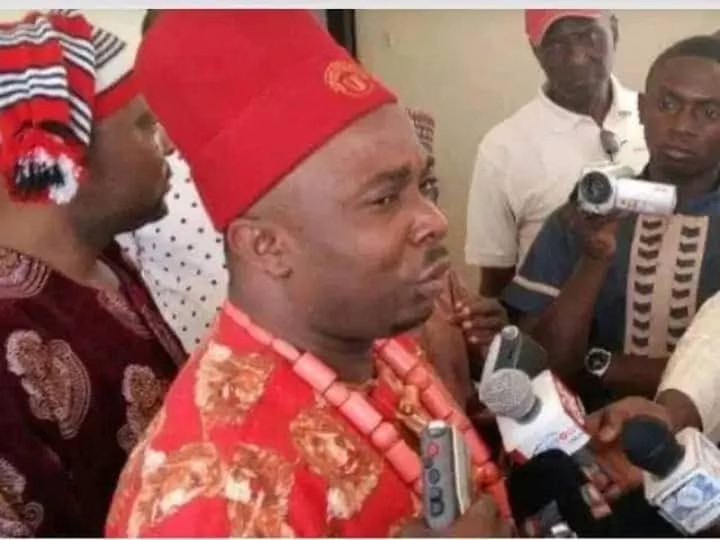
The crisis rocking the Labour Party (LP) has taken a new turn following the forceful takeover of the party’s national secretariat in Abuja by a caretaker committee led by Senator Nenadi Usman.
The takeover happened on Tuesday at the party’s headquarters in Utako, Abuja, weeks after a Federal High Court ruling in January 2026 recognised Nenadi Usman as chairman of a Labour Party caretaker committee. The court decision followed an earlier April 2025 Supreme Court directive ordering political parties to strictly adhere to their constitutions, especially where leadership tenures had expired.
Addressing supporters after gaining access to the secretariat, Senator Usman said the caretaker committee was acting within the law and promised sweeping reforms to reposition the party ahead of future elections. According to her, plans are already underway to introduce electronic membership registration and restructure the party following internal crises that have lingered since the 2023 general elections.
Abia State Deputy Governor, Ikechukwu Emetu, who was present during the takeover, dismissed claims by rival factions that the action was illegal, insisting that the caretaker committee was simply enforcing a valid court judgment.
However, the Julius Abure-led faction of the Labour Party has strongly condemned the action, describing it as a “midnight invasion” carried out with the support of security agencies.
In a statement issued by the party’s National Publicity Secretary, Obiora Ifoh, the Abure faction alleged that hoodlums invaded the secretariat around 1am, pulled down official Labour Party billboards and replaced them with those bearing the name of Senator Nenadi Usman.
The statement further claimed that eight truckloads of police officers were deployed to the secretariat, preventing party staff and senior officials from accessing their offices, while only members loyal to the Nenadi Usman interim leadership were allowed entry.
“The Abure-led leadership is dumbfounded by the invasion of its secretariat by the Nenadi camp aided by the police in the early hours of Tuesday,” the statement read.
According to the faction, offices were forcefully opened and files and other party materials carted away. It added that party officials deliberately avoided confrontation to prevent violence and breakdown of law and order.
While acknowledging that a Federal High Court had recognised Senator Usman as interim chairman, the Abure faction stressed that it had since obtained a stay of execution and filed an appeal against the judgment. It described the takeover as an act of self-help and a violation of due process.
The faction called on the Nigeria Police Force, the Department of State Services (DSS), the Office of the National Security Adviser and other relevant security agencies to urgently intervene, warning that failure to do so could threaten Nigeria’s democratic institutions.
The development once again highlights the deep internal divisions within the Labour Party, as both factions continue to battle for legitimacy amid ongoing court cases and leadership disputes.
Follow BONA NAIJA for more
Politics
Breaking: Nigeria Senate OKs Electronic Transmission of Polling Unit Results to IReV, Keeps Manual Fallback
The Nigerian Senate has approved provisions for the electronic transmission of election results from polling units to the Independent National Electoral Commission’s (INEC) Result Viewing Portal (IReV), while retaining manual collation as a fallback mechanism in cases of technological failure.
This adjustment came during an emergency plenary session on Tuesday, February 10, 2026, following intense public backlash, protests, and calls from civil society groups, opposition figures like Peter Obi, and stakeholders who demanded stronger safeguards ahead of the 2027 general elections.
The upper chamber reconsidered its earlier decision made during the third reading of the Electoral Act 2022 (Repeal and Re-enactment) Amendment Bill 2026 on February 4—to reject mandatory real-time uploads. Instead, senators amended the relevant clause (around Section 60) to accommodate electronic transmission of results, but made it non-mandatory.
The process allows presiding officers to upload results to IReV where technology permits, with manual processes via Form EC8A serving as the primary method if internet or system issues arise.
However, the Senate stopped short of enforcing compulsory real-time transmission or uploads, opting to preserve flexibility for INEC to prescribe the manner of result transfer in line with existing provisions from the 2022 Electoral Act.
This means electronic transmission is permitted and encouraged but not required in all circumstances, drawing criticism from those who argue it fails to fully address past issues of result manipulation at collation centers.
The decision sparked rowdy scenes in the chamber during debates, with some lawmakers protesting the motion to rescind and re-amend the clause. Senate leadership, including President Godswill Akpabio, has maintained that electronic transmission itself was not rejected only the strict “real-time” and mandatory elements were adjusted to avoid potential disruptions in areas with poor connectivity.
The bill, which introduces other electoral reforms, now heads toward harmonization with the House of Representatives’ version, which reportedly endorsed stronger real-time provisions.
Public pressure continues to mount, with groups urging the National Assembly to prioritize transparency and restore confidence in Nigeria’s electoral process for future polls..
Watch video of the plenary HERE
Politics
Nigeria Senate Schedules Emergency Session Over Electoral Act Transmission Backlash
Nigeria’s Senate has scheduled an emergency plenary session for Tuesday, February 10, following widespread backlash over its recent amendments to the Electoral Act, particularly provisions on the electronic transmission of election results.
On February 4, lawmakers passed amendments that leave the electronic transmission of results to the discretion of the Independent National Electoral Commission (INEC), rather than making real-time uploads to the INEC Result Viewing (IREV) portal mandatory. The Senate cited concerns over network failures in parts of the country as justification for the move.
Defending the decision, Senate President Godswill Akpabio argued that a rigid requirement for real-time electronic transmission could expose election outcomes to legal challenges in areas with poor connectivity. He said the amendment was intended to safeguard the electoral process from avoidable technical disputes.
However, the decision has triggered sharp criticism from civil society groups and activists. Prominent rights activist Aisha Yesufu condemned the amendment, warning that it could weaken transparency and open the door to electoral manipulation ahead of the 2027 general elections. Advocacy groups, including Enough is Enough Nigeria, have also accused the Senate of rolling back hard-won electoral reforms.
Amid growing public pressure and plans for nationwide protests, the Senate announced it would reconvene in an emergency session to address concerns surrounding the amendment. The bill is also expected to proceed to the House of Representatives before being forwarded to the President for assent.
The coming days are likely to test public confidence in Nigeria’s electoral reform process, as debate intensifies over the balance between technological limitations and the demand for transparent, credible elections.
Follow BONA NAIJA for more
Politics
Senate Passes Electoral Act Amendment Bill, Retains E-Transmission, Rejects Real-Time Upload of Results
The Senate on Wednesday passed the Electoral Act (Amendment) Bill, 2026, after hours of intense deliberations, clarifying that it did not reject electronic transmission of election results but only turned down a proposal seeking mandatory real-time upload of polling unit results.
The controversy centred on Clause 60 of the bill, which governs the transmission of election results. Lawmakers voted to retain the existing provision in the 2022 Electoral Act, allowing the Independent National Electoral Commission (INEC) to determine the mode of electronic transmission, rather than compelling presiding officers to upload results to the INEC Result Viewing (IReV) portal in real time.
Under the retained clause, presiding officers are required to record votes scored by each candidate on INEC-prescribed forms after counting at the polling unit. The forms must be signed, stamped, and countersigned by party agents where available, before results are announced at the polling unit and transmitted electronically in a manner determined by INEC.
Any presiding officer who wilfully violates the provision risks a fine of up to ₦500,000 or a minimum of six months’ imprisonment upon conviction.
The Senate rejected the proposed amendment that would have expressly mandated real-time electronic transmission of results to IReV after the signing of Form EC8A. Opponents of the proposal argued that the phrase “real time” was vague, impractical in areas with poor network coverage, and could expose the electoral process to unnecessary litigation.
Akpabio: Senate Did Not Reject Electronic Transmission
Amid widespread speculation on social media, Senate President Godswill Akpabio firmly dismissed claims that lawmakers voted against electronic transmission of results.
“That is not true,” Akpabio said. “What we did was to retain the electronic transmission that existed in the 2022 Act. Retaining that provision means electronic transmission remains part of our law. Under my watch, the Senate has not rejected electronic transmission of election results.”
He added that the Senate was “moving forward, not backwards,” stressing that the existing law already allows electronic transmission and was applied during the 2022 elections.
Chairman of the Senate Committee on Media and Public Affairs, Senator Adeyemi Adaramodu, echoed Akpabio’s position, noting that the disagreement was about wording rather than substance.
“Results must be transmitted electronically and made available to the public,” Adaramodu said. “At the same time, physical forms like EC8A will remain evidence. We now have correlating evidence electronic transmission and physical documents.”
He warned against what he described as over-legalising the process with ambiguous terms such as “real time,” arguing that network challenges in remote areas could undermine elections.
Major Changes to Electoral Timelines
Beyond result transmission, the Senate approved sweeping reforms to Nigeria’s electoral calendar. Lawmakers reduced the election notice period from 360 days to 180 days before the expiration of an administration’s tenure.
Political parties are now required to submit their list of candidates not later than 90 days before a general election, while deadlines for nominations were also cut to 90 days.
On voter accreditation, the Senate formally replaced the smart card reader with the Bimodal Voter Accreditation System (BVAS), while retaining the Permanent Voter Card (PVC) as the sole means of voter identification. A proposal to allow alternative voter IDs, including downloadable QR-coded cards, was rejected.
Stricter Penalties, No Political Ban
Lawmakers increased penalties for electoral offences, raising the fine for unlawful possession of voters’ cards from ₦500,000 to ₦5 million. However, the Senate rejected a proposal to impose a 10-year ban on individuals convicted of vote buying and similar offences.
Senator Asuquo Ekpeyong, supported by Akpabio and the Deputy Senate President, argued that while stiffer fines and prison terms were appropriate, a decade-long political ban was excessive.
Rerun Elections for Disqualified Candidates
One of the most far-reaching amendments relates to post-election disputes. Under the new provision, political parties will no longer be allowed to replace candidates disqualified after elections.
Instead, where a returned candidate is found not to have won the majority of valid votes, a rerun election will be conducted, excluding both the disqualified candidate and the sponsoring party.
Adaramodu said the amendment would reduce pre-election litigation and promote democratic fairness.
Next Steps
Akpabio announced the formation of a conference committee chaired by Senator Simon Lalong to harmonise the Senate and House of Representatives versions of the bill. The committee has been mandated to conclude its work within the month to enable transmission of a harmonised bill to the President for assent.
Follow BONA NAIJA for more
Politics
Senator Oshiomhole’s Private Jet Foot Massage Video Sparks Public Backlash
A viral video showing Senator Adams Oshiomhole personally massaging a woman’s feet aboard a private jet has sparked widespread backlash on social media, with many Nigerians criticizing what they describe as a display of luxury amid deepening economic hardship.
The clip, which surfaced on Monday, shows the former Edo State governor seated beside a woman believed to be his wife, Lara Fortes, with her feet resting on his lap as Oshiomhole massages them mid-flight. The video captures clouds visible through the aircraft window and is overlaid with rap lyrics, quickly drawing attention online.
Timing Fuels Criticism
Public outrage intensified due to the timing of the video, coming shortly after Oshiomhole’s January 22 remarks in which he defended the federal government’s economic reforms and urged Nigerians to endure current hardships as necessary sacrifices.
Nigeria is currently grappling with food inflation of about 30 per cent, rising living costs, and declining purchasing power, prompting critics to accuse political leaders of enjoying elite privileges while citizens are asked to tighten their belts.
“This is the problem Nigerians are angry about,” one social media user wrote. “Leaders preach sacrifice while living in comfort.”
Mixed Reactions Online
While many Nigerians slammed the senator for what they described as poor optics and insensitivity, others defended the moment as harmless spousal affection, arguing that Oshiomhole was simply caring for his wife during a private trip.
Supporters maintained that public officials are entitled to personal lives, but critics countered that elected leaders must be mindful of public perception, especially during periods of widespread economic distress.
Wider Debate on Leadership and Accountability
The incident has reignited broader conversations around political accountability, elite privilege, and declining public trust in leadership, with many Nigerians calling for greater modesty and empathy from those in power.
Analysts note that such viral moments, even when personal, can further strain confidence in political leadership at a time when public patience is already thin.
Follow BONA NAIJA for more
-
Entertainment3 weeks agoEgungun of Lagos Interviews IShowSpeed During Nigeria Visit, Clip Goes Viral
-
News3 weeks agoSeyi Vibez and Omah Lay Drop Debut Collaboration ‘My Healer’
-
Feature1 week agoHow Gospel Singer Ifunanya Nwangene Died After Snake Bite in Abuja
-
Sports2 weeks agoChampions League: Full List of Teams Qualified for Round of 16 and Knockout Phase
-
Entertainment2 weeks agoIShowSpeed Wraps 28-Day Africa Tour Across 20 Countries
-
Entertainment3 weeks agoIShowSpeed Hits 50 Million Subscribers on 21st Birthday During Lagos Stream
-
Music News2 weeks agoOmah Lay Celebrates First Grammy Nomination with Davido on ‘With You’
-
News1 week agoWORO MASSACRE: Emir’s Wives, Children, Chief Imam, Teachers, Students Slaughtered as Terrorists Overrun Kwara Town
-
News2 weeks agoVIDEO: Pastor Adeboye Dedicates Lavish Mansion for Ex-PDP Chairman Uche Secondus
-
Music2 weeks agoLekaa Beats Drops “ANGELS” Featuring Omah Lay and Odumodublvck