
News
TV personality Zainab Balogun reveals how she met her hubby and how his kids reaction when she told them she was going to be their new mum



Some time middle last year Tv/media personality zainab Balogun, stunned everyone when she got married to her husband, Dikko Nwachukwu, the owner of Jetwest Airways, in May. Nwachukwu, at the time, was a widower whose wife died in 2015.
In an interview with Bolanle Olukanni for Ndani TV, Zainab revealed how she met nwachukwu who is quite older and widowed from his first marriage and how life as a step mum to her husband’s two sons as been.
She said:

”I honestly didn’t envision I would get married as soon as I did. For me It has always been about connections. I have never particularly dated guys for what they had or what they can give me. So when you meet someone that is the definition of kindness, of partnership, of love, of understanding, it just makes life easy. I think that is when you know somebody is for you, when it is not hard, when you don’t have to beg someone for attention, when you don’t have to communicate with you, they love what you do, they push you. It feels effortless.
So we were friends. We were introduced by a mutual friend, comedian Chigurl. She has got the spirit. I don’t know how many marriages Chioma has got under her belt. She was I have a guy that really likes you. We always joke and call you Slaynab. So we met, we had coffee. I wasn’t sure so I was like we should just be really good friends. We just built a really good bond and he became someone that I would talk to all the time” she said
On how it was like when she first met his children, Zainab said
”At first I was Aunty Zainab and I remember my husband saying they really like you. I was like how can you tell and he was like suddenly, they are performing for you. They normally don’t do that. Then we started spending time together, doing all the fun stuff”
teary zainab said “i will never ever forget when we told them that we were going to get married. It was such a special moment. I remember they were sitting down and I was recording, they didn’t know I was recording and I said to them that me and Daddy are thinking getting married.. so how would you feel if I became your mum and we got married? It was so weird they burst into tears.
They were so happy and for me, it just made sense”



Comments by Tosin Eniolorunda, CEO of Moniepoint, have sparked a heated debate online after he questioned the quality of Nigeria’s talent pool while discussing his company’s hiring challenges.
Speaking at the The Platform Nigeria on May 1, Eniolorunda said the fintech firm had advertised over 500 vacancies since 2024 but struggled to find qualified local candidates. He revealed that by 2025, the company reversed its local-only hiring policy due to the shortage.
“I used to feel Nigerians are really bright… but we are still struggling to find Nigerians to fill those roles. They don’t meet global standards,” he said, attributing the gap to factors such as social media distractions, cybercrime, hookup culture, and weaknesses in the education system.
Backlash and Counterarguments
His remarks triggered swift backlash from Nigerians, particularly within the tech community, with many accusing local companies of failing to invest in talent development.
Critics argued that unlike global firms, Nigerian tech companies rarely offer structured, paid internship programs or training pipelines to groom young professionals. Some pointed to examples of international companies like Oracle Corporation, where internships and early talent programs serve as entry points into full-time roles.
Others shared personal experiences of being rejected by local firms despite strong resumes, while noting that Nigerian professionals continue to secure roles in global companies such as Amazon.
A recurring sentiment online was that many Nigerian companies demand “global-standard talent” but are unwilling to offer competitive compensation or career development opportunities.
Industry Perspective
Supporters of Eniolorunda’s stance, however, pointed to the realities of scaling a fast-growing fintech company in a competitive global market. They cited brain drain, limited specialized skills, and increasing demand for top-tier expertise as genuine challenges facing Nigerian startups.
Analysts say the controversy highlights a broader issue within Nigeria’s tech ecosystem balancing expectations between employers and job seekers, while addressing gaps in education, training, and remuneration.
The debate mirrors ongoing tensions around talent development, compensation, and hiring practices in Nigeria’s fast-evolving tech sector.
As companies expand and compete globally, the question of how to build, retain, and fairly reward talent is likely to remain a central issue.
i
Follow BONA NAIJA for more

A Nigerian soldier has allegedly assaulted a journalist, Fakoyejo Olalekan, during a traffic control operation in Lagos State, triggering widespread public condemnation after video footage of the incident surfaced online.
The clash occurred on May 2 near Pleasant Event Centre in Ikeja, where personnel of the Nigerian Army were reportedly directing heavy traffic.
According to eyewitness accounts, the altercation began after Fakoyejo remarked to passengers that a soldier’s handling of a motorcyclist had caused an unnecessary delay. The comment allegedly angered one of the soldiers, who ordered everyone out of the vehicle.
The situation escalated when the soldier reportedly slapped and shoved the journalist, and briefly reached for a piece of wood before bystanders intervened to prevent further escalation.
Video clips circulating on social media show at least two soldiers involved in the confrontation. During the incident, Fakoyejo’s phone screen was also seen shattered on the pavement. No serious injuries were reported.
The footage has since triggered widespread criticism online, with many users calling for accountability and questioning the conduct of military personnel during civilian traffic enforcement duties.
As of May 4, the Nigerian Army had yet to issue an official response despite being tagged in multiple public complaints and posts about the incident.
Follow BONA NAIJA for more


The Department of State Services (DSS) on Monday arraigned Chidiebere Justice Mark, popularly known as Justice Crack, before the Federal High Court sitting in Abuja on a three-count charge bordering on cybercrime and alleged incitement against the military.
Mark was earlier arrested by the Nigerian Army over a viral video and accompanying statements he shared via his X (formerly Twitter) handle, @JusticeCrack, in which he reportedly alleged inadequate feeding of Nigerian soldiers.
According to the charge sheet, the defendant is accused of knowingly circulating false information intended to provoke public annoyance, ill will, and hatred among citizens.
Details of Charges
Count One alleges that on April 28, 2026, Mark disseminated information on social media regarding poor feeding conditions of Nigerian Army personnel, which authorities claim he knew to be false. The offence is said to contravene Section 24(1)(b) of the Cybercrimes (Prohibition, Prevention, etc.) Act, 2015 (as amended).
Count Two states that the accused published a viral video and statements about the Nigerian Army that triggered widespread negative reactions and were likely to cause fear and a breach of peace. This charge is brought under Section 59 of the Criminal Code Act.
Count Three accuses Mark of attempting to commit a felony by circulating what authorities described as derogatory content about the Army, also linked to potential public unrest, punishable under Section 509 of the Criminal Code Act.
Court Proceedings
Presiding judge, Joyce Abdulmalik, adjourned the case to May 25, 2026, for trial and possible hearing of a bail application. The court also ordered that the defendant be remanded in DSS custody pending further proceedings.
Public Reaction
The arraignment has sparked widespread reactions across social media, with civil rights advocates and concerned citizens debating issues around freedom of expression, national security, and the limits of online speech in Nigeria.
Follow BONA NAIJA for more

The Nigerian Army has clarified the circumstances surrounding the arrest of social media influencer Justice Mark Chidiebere, popularly known as “Justice Crack,” following complaints raised online.
In a statement issued on May 2, 2026, and signed by Appolonia Anele, Acting Director of Army Public Relations, the military said the arrest was linked to an ongoing investigation into alleged violations of the Armed Forces’ social media policy and attempts to misinform the public.
According to the Army, the development began after some soldiers reportedly raised concerns about feeding and welfare issues, which were later shared on social media by Chidiebere.
However, preliminary findings suggest that the influencer engaged the soldiers in conversations that went beyond welfare concerns, including discussions the Army described as bordering on subversion.
“Preliminary report reveals that the soldiers discussed a wide range of issues with Justice Chidiebere who seemed to be inciting soldiers to create discontent within the system,” the statement said.
The Army warned that any attempt by civilians to influence military personnel towards acts that could undermine discipline poses serious risks to national security.
“It is important to state that a situation where civilians cultivate vulnerable personnel towards acts of subversion has far-reaching implications on discipline and national security,” the statement added.
Following the development, Chidiebere was arrested alongside the soldiers involved. While the soldiers remain in military custody, he has been handed over to relevant civil authorities for further investigation and possible prosecution.
The Army reaffirmed its commitment to due process and the rule of law, stressing that all actions taken were within legal bounds.
“The Nigerian Army remains committed to the rule of law and will continue to collaborate with relevant agencies to ensure justice is served,” Anele stated.
The case has drawn public attention amid ongoing conversations about military welfare and freedom of expression on social media.
Follow BONA NAIJA for more
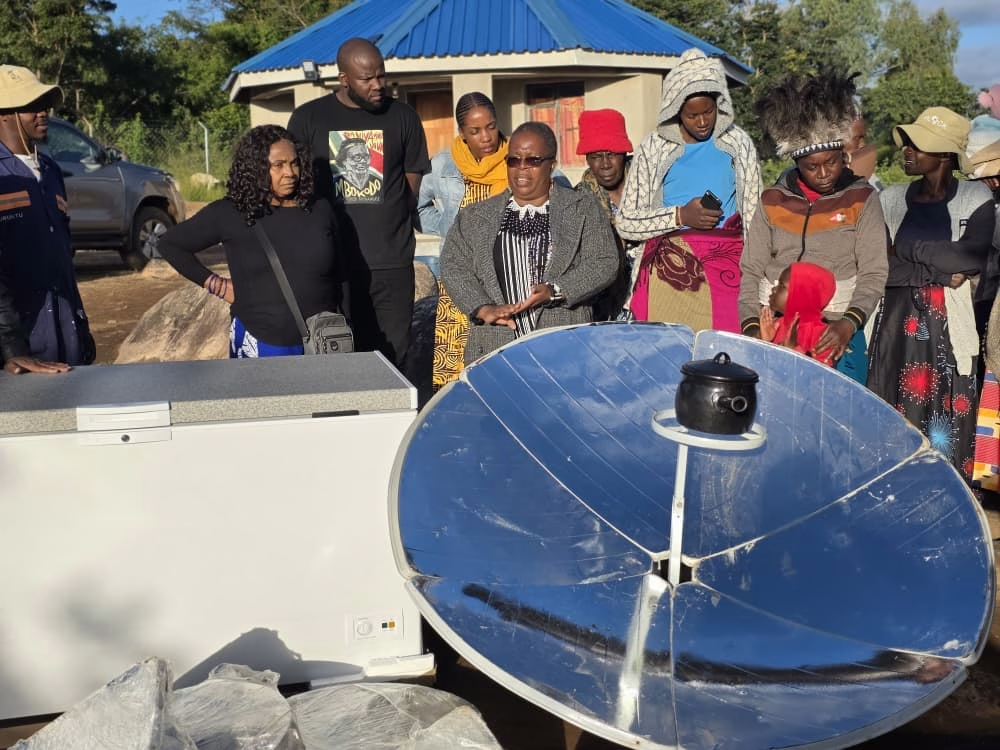
Harare, Zimbabwe 2026 – As global demand for critical minerals accelerates to support the clean energy transition, feminist advocates across Africa are calling for greater justice, inclusion, and protection for women in mineral-rich communities who say they are being left behind.
The concerns are growing in regions where minerals such as lithium and cobalt are increasingly extracted to power electric vehicles, solar technologies, and battery systems. While the transition to green energy is being celebrated globally, many grassroots communities describe a different reality marked by land loss, environmental degradation, and exclusion from decision-making.
In Zimbabwe’s Bikita region, Acting Village Head of the Vatombe community, Gamuchirai Munesi, said lithium mining has become a major threat to local livelihoods and cultural heritage.
“Lithium mining has become a curse. It threatens our mountains, our water sources, and the land that has sustained the Vatombe people for generations,” she said.
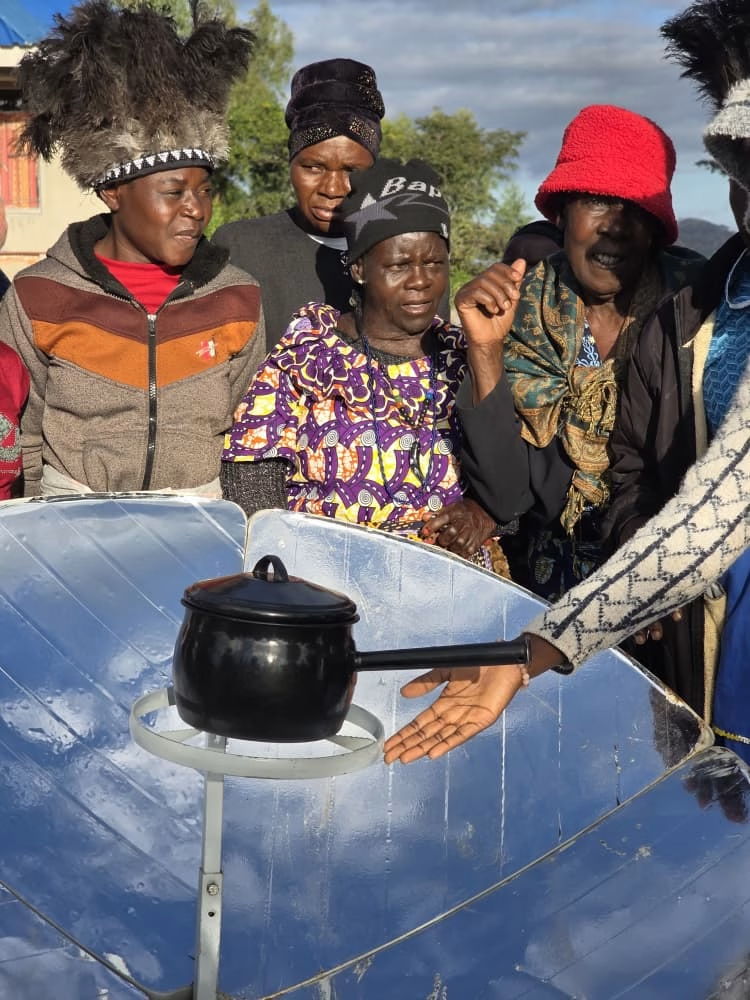
Munesi made the remarks during a recent story circle event in Hanyanya, an initiative that brought together grassroots women, eco-feminists, and climate justice activists. The event was organised by SHINE Collab and partners, focusing on community-driven dialogue and inclusion.
Story circles, which are structured dialogue sessions aimed at encouraging shared storytelling and active listening, are increasingly being used by civil society groups to elevate voices often excluded from formal policy spaces.
Executive Director of SHINE Collab, Dr Mela Chiponda, said the current energy transition risks replicating historical inequalities if women’s voices are not integrated into decision-making processes.
“The transition to clean energy cannot be built on the same extractive logic that has historically marginalised women,” she said. “This moment demands that we rethink power who holds it, who benefits, and how women, particularly at the grassroots, can shape these systems.”
She warned that current extractive models mirror colonial-era patterns, where resources are exported for global benefit while local communities bear environmental and social costs. These include insecure land rights, increased unpaid care work, and heightened risks of gender-based violence.
A recent study by the United Nations University Institute for Water, Environment and Health also highlights concerns over the environmental and social impacts of critical mineral extraction. The report warns that mining essential materials such as lithium and cobalt can intensify water insecurity and environmental degradation in vulnerable regions.
“Technological disruptions are necessary,” said UNU-INWEH Director Kaveh Madani. “But we must address their unintended consequences. A transition cannot be called green, sustainable, or just if it shifts environmental harm from the rich to the poor, or from one region to another.”
Across the Southern African Development Community (SADC) and the Great Lakes region, women in mining communities continue to report displacement and exclusion from compensation and ownership structures, despite their central role in local economies.
Evidence from the Democratic Republic of the Congo has also linked mining activities to pollution, child labour, and sexual violence impacts that disproportionately affect women and children.
Advocates are now calling on governments, development banks, and private sector actors to adopt feminist principles in climate and energy strategies, ensuring transparency, accountability, and meaningful participation for women at every stage of the value chain.
As competition intensifies for Africa’s critical minerals, feminist groups say the future of the energy transition must be not only sustainable but also equitable.
Follow BONA NAIJA for more

Lookman Spotted in London Ahead of Arsenal vs Atletico UCL Showdown

2027 Bombshell: Ohanaeze Tells Peter Obi to Step Down for Tinubu

Burna Boy Splashes $100,000 on 6uff, Odumodublvck at Lagos Club Night

Nigerians Slam Moniepoint CEO Over ‘Talent Quality’ Remarks Amid Hiring Debate

Outrage as Soldier Assaults Journalist Over Traffic Dispute in Lagos

Outrage as DSS Arraigns Chidiebere Justice Mark Over Alleged Cybercrime, Military Incitement

Video: Fresh Blow to Obi–Kwankwaso Plan as Datti Questions Northern Backing ahead of 2027

PDP NEC Approves 13-Member Caretaker Committee Amid Internal Party Rift

NDI-ABAT Condemns Buba Galadima Over Alleged Incitement, Calls for Probe Ahead of 2027 Elections
Ohanaeze Blasts Peter Obi Over “Nigerian, Not Igbo” Remark Ahead of 2027

News Flash: Court Suspends Secondus As PDP National Chairman, Member

2019 Presidency: Donald Duke’s Running Mate Quites Race Allegedly joins Atiku

Falana threaten to sue Kachikwu over $60bn oil revenue loss

#BONANAIJATV: Exclusive interview with OMPAN National President Comr Emeh James Anyalekwa #ompanowerri2018

Video : Phyno – Agu
Philippines president, Rodrigo Duterte brags about the size of his manhood

Video: Burna Boy – “Dangote”

VIDEO: Becca – Magic ft. Ycee

VIDEO: Patoranking x Davido – Confirm
TV personality Zainab Balogun reveals how she met her hubby and how his kids reaction when she told them she was going to be their new mum

Video: Screening of Former Governor of Kaduna State, Elrufai

OLISAE Rolls Out Video for New Song “SAMBELE” featuring Slowdog

Video: Dino Melaye mocks Tinubu during the PDP rally In Delta

Video: Shettima & I Will Not Abuse Each Other Like Obasanjo & Atiku – Bola Tinubu

Watch Sabinus’ Comedy on Tinubu, Peter Obi, other presidential candidates

Video: Buju feat. Burna Boy – Lenu (Remix)

VIDEO: Sammie Okposo – Nobody Can

VIDEO: Falz – Bop Daddy ft. Ms Banks

Watch Diane Russet’s Short Film “Bayi”

Video: Acoustic Performance of Patoranking’s “So Nice”


-

 Jobs3 weeks ago
ECOWAS Recruitment 2026: Massive Job Openings Across West Africa (Apply Now)
-
 Jobs3 weeks ago
Germany Embassy Abuja Announces Job Vacancy
-

 Jobs3 weeks ago
EU Invites Nigerian Graduates to Apply for 2026 Funded Traineeship in Abuja
-

 Jobs3 weeks ago
Research Interviewers Job: Jhpiego Hiring Across 36 States & FCT
-
 News3 weeks ago
Supreme Court Dismisses David Mark’s Application, Deepening ADC Leadership Crisis Ahead of 2027 Polls
-
 Music Video2 weeks ago
Fally Ipupa & Wizkid Ignite Charts with ‘JAM’ Video from XX Album
-

 Events3 weeks ago
Emiralty Africa to Host ‘Emiralty Connect 1.0’ Summit in Lagos
-
 News2 weeks ago
Captured Boko Haram Suspect Alleges Links to Senior Military Figure in Viral Interrogation Video
-
 Politics2 weeks ago
2027: Obi, Kwankwaso Supporters Launch ‘OK Movement’ Ahead of ADC Presidential Primary
-

 Politics3 weeks ago
ADC National Convention: Security Beefed Up as 3,000 Delegates Elect New NWC