News
Iran Confirms Death of Supreme Leader Ali Khamenei After US-Israeli Strikes

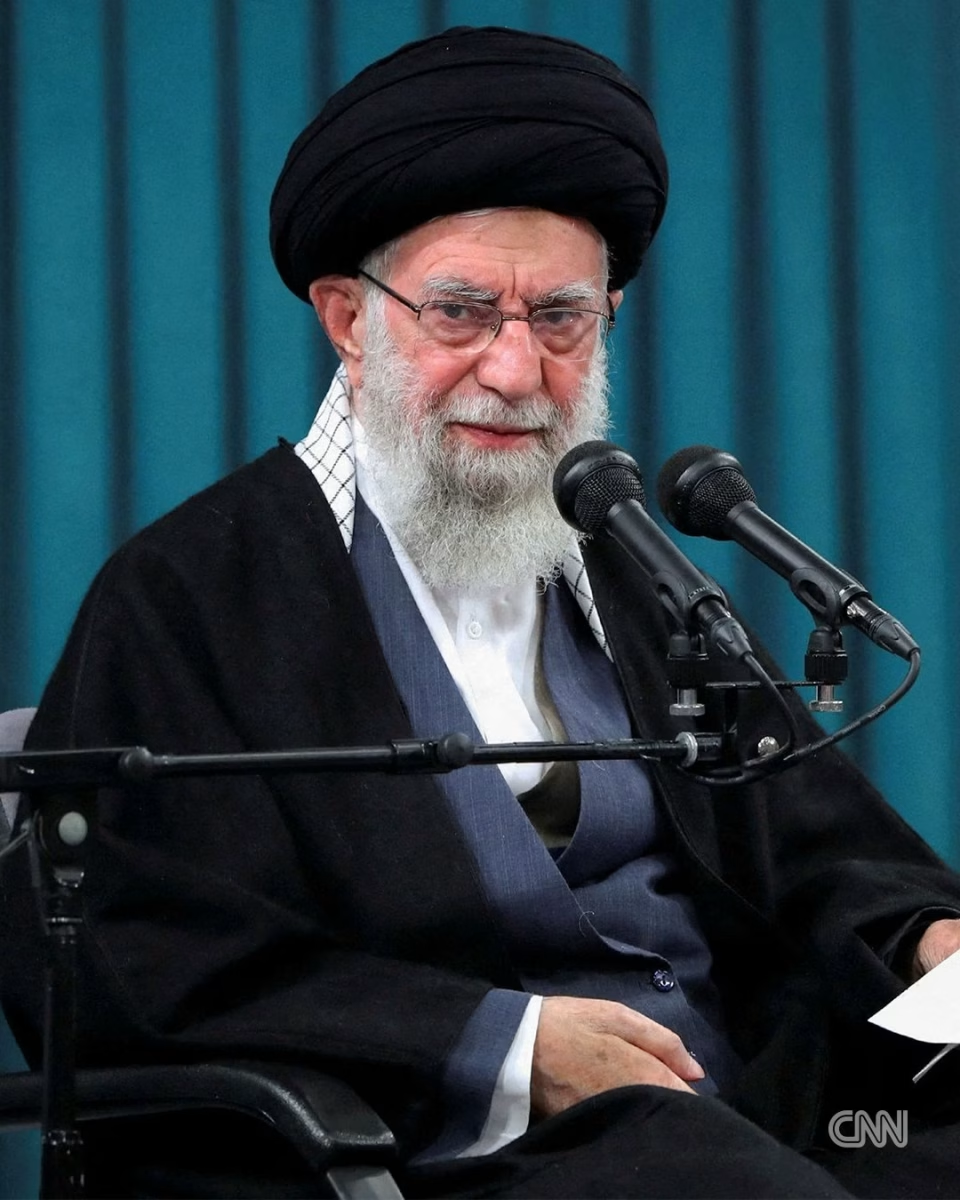

Iranian state television has confirmed that Supreme Leader Ali Khamenei was killed in joint US-Israeli air strikes, marking a dramatic escalation in the ongoing conflict and plunging the region into uncertainty.
According to state media, the 86-year-old leader was killed at his office during coordinated attacks that began early Saturday. Authorities have announced a 40-day national mourning period following the confirmation.
The announcement came after earlier reports by Iranian news agencies Tasnim and Mehr had suggested that Khamenei remained “steadfast and firm in commanding the field.” However, confirmation later followed statements by US President Donald Trump, who wrote on his Truth Social platform that Khamenei had been killed in the strikes.
“He was unable to avoid our Intelligence and Highly Sophisticated Tracking Systems,” Trump stated, adding that the operation was conducted in close coordination with Israel. He described the development as a potential turning point for the Iranian people and signaled that further military action could continue “as long as necessary.”
Israeli Prime Minister Benjamin Netanyahu had earlier claimed there were “growing signs” that Khamenei had been killed, while international media cited unnamed officials who said his body had been located.
Khamenei had served as Iran’s supreme leader since 1989, succeeding Ruhollah Khomeini, the leader of the 1979 Iranian Revolution. As supreme leader, he held ultimate authority over Iran’s executive, legislative, and judicial branches, as well as the armed forces.
Heavy Casualties and Continued Strikes
Saturday’s wave of strikes reportedly targeted 24 provinces across Iran, with Iranian media citing Red Crescent figures that at least 201 people were killed. Among the targets were schools in the southern city of Minab and areas east of Tehran, resulting in significant civilian casualties.
Netanyahu said that multiple “senior figures” in Iran’s Revolutionary Guard and nuclear program had been eliminated. Meanwhile, Trump indicated that “heavy and pinpoint bombing” could continue throughout the week.
Iran’s Islamic Revolutionary Guard Corps (IRGC) said it had launched multiple waves of retaliatory strikes against US and Israeli positions. Air-defense systems were reportedly activated in countries hosting US military assets, including Kuwait, Qatar, the United Arab Emirates, and Bahrain.
Global Reactions and Calls for De-escalation
Antonio Guterres, Secretary-General of the United Nations, told an emergency Security Council meeting that he regretted diplomacy had been “squandered” and warned of uncontrollable consequences.
“Military action carries the risk of igniting a chain of events that no one can control,” he said, calling for an immediate cessation of hostilities.
Iran’s ambassador to the UN condemned the strikes as an act of aggression and described them as violations of international law. The US ambassador defended the operation as lawful, reiterating Washington’s stance that Iran must not obtain nuclear weapons.
China and Russia also expressed concern, with their UN envoys urging restraint and an immediate halt to further military action.
Uncertainty Over Iran’s Leadership
Analysts say Iran has long prepared contingency plans in the event of Khamenei’s death. Barbara Slavin of the Stimson Center suggested that a governing council may temporarily oversee state affairs, adding that such arrangements could already be in place.
Khamenei’s death marks one of the most consequential moments in Iran’s modern history and introduces fresh uncertainty into an already volatile regional conflict.
Follow BONA NAIJA for more