Connect with us

Africa

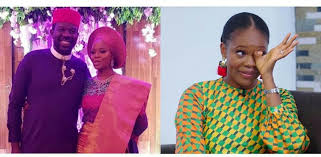
Why Chidimma Adetshina’s mother, Anabela was arrested, detained — South African govt.

Published

on

Chidimma Adetshina’
Share for social good

South African authorities have clarified the reasons behind the recent arrest and detention of Anabela Rungo, the mother of Chidimma Adetshina, the reigning Ms Universe Africa and Oceania.

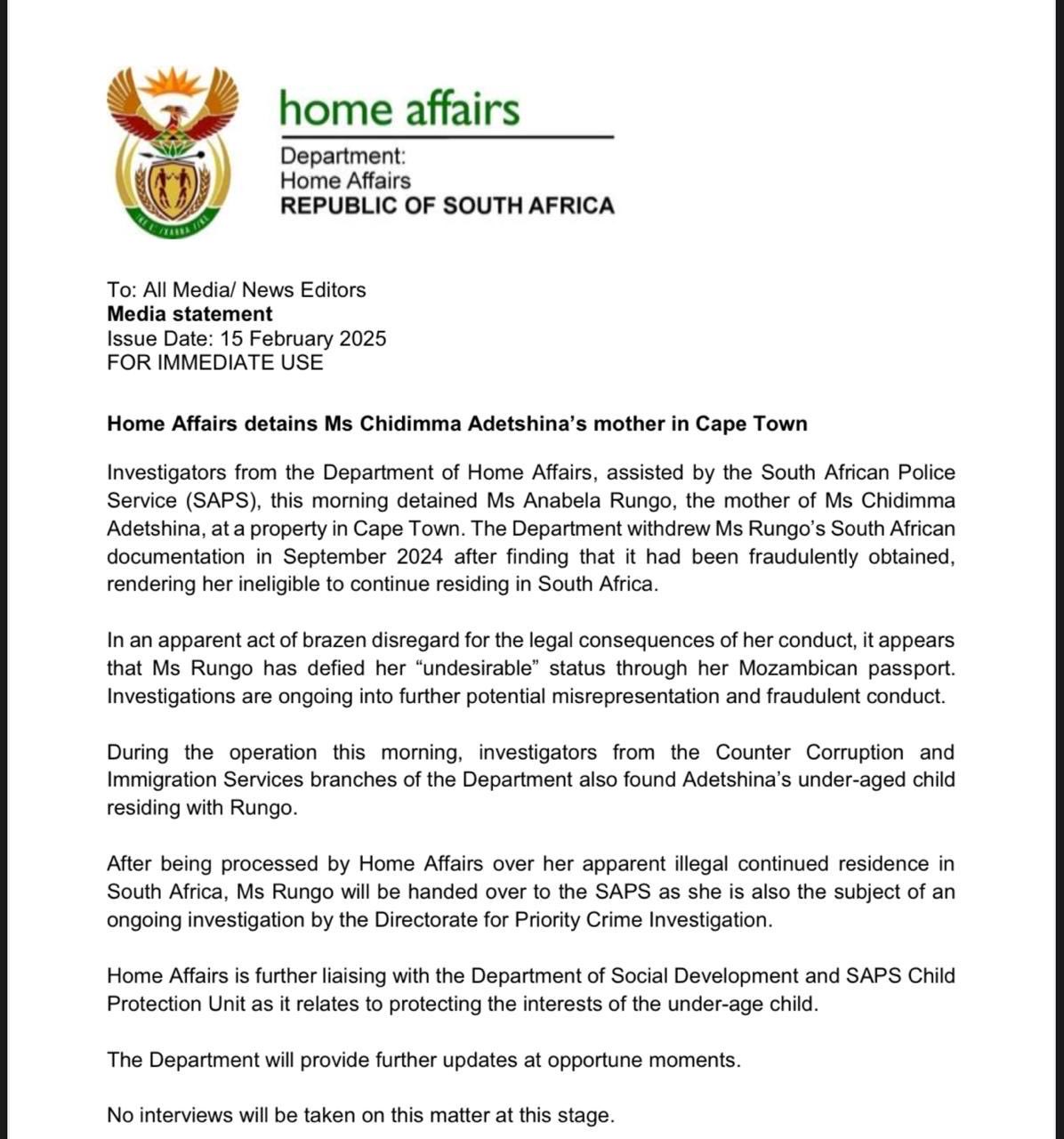
The arrest, carried out by the Department of Home Affairs, follows allegations of fraudulent activity surrounding Rungo’s South African documentation.

Home Affairs officials stated that Rungo had continued to reside in the country despite having her residency status revoked in September 2024.

The revocation came after it was discovered that her identity documents had been obtained fraudulently, rendering her ineligible to remain in South Africa.

FIRS

Rungo was detained following her arrest in Cape Town during a joint operation conducted by Home Affairs investigators and the South African Police Service (SAPS) over the weekend.

Siya Qoza, spokesperson for the Department of Home Affairs, explained the situation, stating, “Investigators from the department, assisted by SAPS, detained Anabela Rungo at a property in Cape Town.
The Department withdrew Rungo’s South African documentation in September 2024 after finding that it had been fraudulently obtained, rendering her ineligible to continue residing in South Africa.”

Qoza further noted that despite being declared persona non grata, Rungo defied the country’s immigration laws and remained in South Africa. “It appears that Rungo has defied her ‘undesirable’ status through her Mozambican passport. Investigations are ongoing into further potential misrepresentation and fraudulent conduct,” he added.

Following processing by Home Affairs for her unlawful stay, Rungo will be handed over to SAPS, as she is also under investigation by the Hawks, South Africa’s elite crime-fighting unit.

An immigration lawyer, Ashraf Essop, told eNCA that individuals in Rungo’s position typically have two options once their documents are invalidated: “You either leave the country on your own, or be detained and deported.”

However, Essop pointed out that the circumstances surrounding the invalidation of Rungo’s documents remain unclear. He also suggested that Rungo could have avoided detention by voluntarily surrendering her documents, which would have facilitated her deportation.

Rungo’s detention comes amid controversy surrounding her daughter, Chidimma Adetshina, who faced scrutiny after initially being deemed ineligible to participate in the Miss South Africa beauty pageant due to her non-South African citizenship.

Adetshina later withdrew from the competition after facing online bullying. She eventually went on to win the Miss Universe Nigeria 2024 title and emerged first runner-up in the Miss Universe 2024 competition.

Share for social good
CLICK TO GET A WhoGoHost Hosting PLAN
Continue Reading
Advertisement
Click to comment

Leave a Reply

Your email address will not be published. Required fields are marked *

This site uses Akismet to reduce spam. Learn how your comment data is processed.

Africa

Feminist Voices Demand Justice and Inclusion in Africa’s Critical Minerals Boom

Published

on

Dr-Mela-Chiponda-with-dark-spects-talks-to-women-during-the-presentation-of-a-solar-cooker-to-women-groups-in-Bikita-Zimbabwe.
Share for social good

Harare, Zimbabwe 2026 – As global demand for critical minerals accelerates to support the clean energy transition, feminist advocates across Africa are calling for greater justice, inclusion, and protection for women in mineral-rich communities who say they are being left behind.

The concerns are growing in regions where minerals such as lithium and cobalt are increasingly extracted to power electric vehicles, solar technologies, and battery systems. While the transition to green energy is being celebrated globally, many grassroots communities describe a different reality marked by land loss, environmental degradation, and exclusion from decision-making.

In Zimbabwe’s Bikita region, Acting Village Head of the Vatombe community, Gamuchirai Munesi, said lithium mining has become a major threat to local livelihoods and cultural heritage.

“Lithium mining has become a curse. It threatens our mountains, our water sources, and the land that has sustained the Vatombe people for generations,” she said.

FIRS

Munesi made the remarks during a recent story circle event in Hanyanya, an initiative that brought together grassroots women, eco-feminists, and climate justice activists. The event was organised by SHINE Collab and partners, focusing on community-driven dialogue and inclusion.

Story circles, which are structured dialogue sessions aimed at encouraging shared storytelling and active listening, are increasingly being used by civil society groups to elevate voices often excluded from formal policy spaces.

Executive Director of SHINE Collab, Dr Mela Chiponda, said the current energy transition risks replicating historical inequalities if women’s voices are not integrated into decision-making processes.

“The transition to clean energy cannot be built on the same extractive logic that has historically marginalised women,” she said. “This moment demands that we rethink power who holds it, who benefits, and how women, particularly at the grassroots, can shape these systems.”

She warned that current extractive models mirror colonial-era patterns, where resources are exported for global benefit while local communities bear environmental and social costs. These include insecure land rights, increased unpaid care work, and heightened risks of gender-based violence.

A recent study by the United Nations University Institute for Water, Environment and Health also highlights concerns over the environmental and social impacts of critical mineral extraction. The report warns that mining essential materials such as lithium and cobalt can intensify water insecurity and environmental degradation in vulnerable regions.

“Technological disruptions are necessary,” said UNU-INWEH Director Kaveh Madani. “But we must address their unintended consequences. A transition cannot be called green, sustainable, or just if it shifts environmental harm from the rich to the poor, or from one region to another.”

Across the Southern African Development Community (SADC) and the Great Lakes region, women in mining communities continue to report displacement and exclusion from compensation and ownership structures, despite their central role in local economies.

Evidence from the Democratic Republic of the Congo has also linked mining activities to pollution, child labour, and sexual violence impacts that disproportionately affect women and children.

Advocates are now calling on governments, development banks, and private sector actors to adopt feminist principles in climate and energy strategies, ensuring transparency, accountability, and meaningful participation for women at every stage of the value chain.

As competition intensifies for Africa’s critical minerals, feminist groups say the future of the energy transition must be not only sustainable but also equitable.

Follow BONA NAIJA for more


Share for social good
CLICK TO GET A WhoGoHost Hosting PLAN
Continue Reading

Africa

Crowds Protest Illegal Immigration in South Africa, Demand Tougher Enforcement

Published

on

South Africa illegal immigration protests
Share for social good

Large crowds gathered in Johannesburg on Wednesday to protest against illegal immigration, as tensions between locals and foreign nationals continue to rise across South Africa.

The demonstration follows a similar protest held a day earlier in Pretoria, signaling a broader wave of coordinated actions by anti-immigration groups demanding stricter enforcement of immigration laws.

Calls for Deportation and Rule of Law

Protesters are urging authorities to clamp down on undocumented migration and implement mass deportations, arguing that illegal immigration is placing pressure on jobs, public services, and economic opportunities.

FIRS

Speaking during the march, Tshepo Totwe, secretary of the Abahambe Movement, rejected claims that the protests were driven by xenophobia.

“We are being labelled as xenophobic, and that is not the point. We are emphasising our constitutional rights and calling for enforcement of the law,” he said.

Another protest leader, Sanele Nkambule, called on the government to respond formally to the concerns raised by demonstrators.

“We call on the government to affirm its commitment to uphold the rule of law, enforce existing legislation, and prioritise the safety and socioeconomic well-being of South Africans,” Nkambule stated.

Rising Tensions and Public Debate

The protests come amid growing debate over immigration policy in South Africa, with some citizens blaming undocumented migrants for economic challenges, while others warn against escalating tensions that could lead to xenophobic violence.

Authorities have yet to issue a detailed response to the latest demonstrations, though previous incidents of similar protests have drawn international concern over the safety of foreign nationals.

Observers say the situation underscores the need for balanced policies that address both economic pressures and the rights of migrants.

Follow BONA NAIJA for more


Share for social good
CLICK TO GET A WhoGoHost Hosting PLAN
Continue Reading

Africa

Sadio Camara Killed in Coordinated Attacks on Military Sites in Mali

Published

on

MALI - FLAG
Share for social good

Mali’s Defence Minister, Sadio Camara, has reportedly been killed during coordinated attacks targeting military installations across the country, according to sources cited by Al Jazeera.

The development was confirmed on Sunday, a day after his residence in Kati came under heavy attack amid simultaneous assaults by armed groups, including an al-Qaeda-linked faction and Tuareg rebels.

Mali Defence Minister Sadio Camara Killed in Coordinated Military Attacks
Mali’s Defence Minister, Sadio Camara

According to reports, fighters launched a large-scale offensive that included a vehicle-borne explosive attack on Camara’s residence in Kati, a key military town located about 15 kilometres from the capital, Bamako.

Camara was considered one of the most powerful figures within Mali’s military leadership, playing a central role in the coups of 2020 and 2021 that brought the current government to power. He was also widely seen as a potential future leader of the country.

FIRS

Security analysts say his death represents a significant setback for the country’s armed forces, already facing ongoing insurgent threats in various regions.

The attacks were reportedly carried out by the al-Qaeda-linked group Jama’at Nusrat al-Islam wal-Muslimin in collaboration with Tuareg fighters from the Azawad Liberation Front.

Meanwhile, Mali’s interim president, Assimi Goita, was said to be safe and had been moved to a secure location following the incident. He remains in control of the country’s military leadership.

The situation remains tense as authorities assess the scale of the attacks and their implications for national security.

Mali govt confirms defence minister, mosque worshippers killed in terrorist attack 

The military government of Mali has confirmed the killing of its minister of defence, Sadio Camara, and unspecified number of civilians during terrorist attack on Saturday.

In statement on Sunday, the Malian government said Mr Camara died as a result of injuries sustained in a car bombing at his residence on Saturday.

“The Transitional Government of Mali deeply regrets to inform the public of the tragic death of Lieutenant General Sadio Camara, Minister of State, Minister of Defense, following the cowardly terrorist incidents that occurred on the morning of April 25, 2026, a car bomb driven by a suicide bomber targeted the minister’s residence,” the statement stated.

According to the statement Mr Camara, engaged in an exchange of fire with the assailants, some of whom he managed to kill.

During intense clashes, he was wounded and then transported to the hospital, where he succumbed to his injuries.

It added that other people were killed during the attack due to collapse of Mr Camara’s building and a nearby mosque. But the number of the victims was not disclosed.

“The collapse of his residence caused other casualties and the destruction of a nearby mosque, resulting in the deaths of some worshippers inside,” the statement stated.

Mali’s president of transition, General Assimi Goita, extended condolences to Mr Camara’s family, adding “These condolences are also extended to all the civilian and military victims who died during the terrorist incidents of April 25, 2026.”

“For his decidication to service and distinguished career, Mr Camara will be granted a national funeral, which will be announced in a press release.”

On Saturday, Al-Qaeda affiliate and Tuareg rebels launched attacks across Mali, causing temporarily shutdown of the country’s main airport as explosions rocked different locations in the country.

Follow BONA NAIJA for more


Share for social good
CLICK TO GET A WhoGoHost Hosting PLAN
Continue Reading

Africa

Ghana Police Arrest ‘End-Time Prophet’ Over Doomsday Flood Prophecy

Published

on

Ghana Police Arrest Prophet Ebo Noah Over Christmas 2025 Doomsday Flood Prophecy
Share for social good

Ghanaian police have arrested self-proclaimed prophet Evans Eshun, popularly known as Ebo Noah, following an end-of-the-world prophecy that sparked public panic across Ghana and online communities globally.

Eshun was taken into custody by the Inspector General of Police (IGP) Special Cyber Vetting Team, as part of intensified security measures aimed at curbing cyber-related and panic-inducing activities ahead of 31st night religious services, authorities confirmed.

The controversial cleric had gained international attention after claiming he received a divine revelation that the world would end on Christmas Day, 2025, through a massive global flood. According to his claims, only those who sought refuge inside specially constructed “arks” would survive the catastrophe.

FIRS

Last month, Eshun escalated fears after reportedly constructing eight arks, insisting that divine instructions mandated the move. Images and videos of the structures quickly went viral, igniting fear, curiosity, mockery, and heated debate across social media platforms.

Security sources say the prophet’s actions and online messages were being monitored due to concerns over public order, misinformation, and digital panic, particularly as end-of-year religious gatherings approach.

While police have not yet disclosed the specific charges, officials reiterated that spreading false prophecies capable of inciting fear and disrupting public peace would not be tolerated.

The arrest has triggered mixed reactions, with some followers defending Eshun’s claims as spiritual revelations, while others have welcomed police intervention, warning of the dangers of unchecked religious sensationalism in the digital age.

Investigations are ongoing.

Follow BONA NAIJA for more


Share for social good
CLICK TO GET A WhoGoHost Hosting PLAN
Continue Reading

Africa

Ghanaian Man Retracts Doomsday Prediction, Says God Has Granted More Time Before Rapture

Published

on

Ghanaian Man Withdraws Doomsday Prophecy, Says God Gave More Time Before Rapture
Share for social good

Ghanaian Man Withdraws Doomsday Prophecy, Says God Gave More Time Before Rapture

A Ghanaian man, Ebo Noah, who recently drew widespread attention after predicting that the world would end “today,” has announced that the apocalyptic event will no longer take place as earlier declared.

In a follow-up message that circulated widely on social media, Noah said the change came after he pleaded with God for mercy, claiming that his prayers were answered and that humanity had been granted more time.

According to him, the delay is purposeful, as God has allegedly given him an extended period to build more arks to accommodate people before the eventual rapture.

“The world will not end today as I said earlier. I pleaded with God and He has given us more time,” Noah reportedly stated. “I have been instructed to build more arks so that more people can be saved.”

Public Reaction and Online Debate

Noah’s initial prophecy sparked intense reactions online, ranging from fear and anxiety to mockery and skepticism. His subsequent announcement triggered a fresh wave of debate, with many social media users questioning the credibility of his claims, while others expressed relief or amusement at the reversal.

FIRS

Some critics accused him of spreading fear and misinformation, while a small number of followers urged people to take the message seriously, framing it as a call for repentance rather than a literal prediction.

Religious Leaders Urge Caution

Although Noah has not been officially linked to any recognized church or religious institution, several religious commentators have advised the public to exercise caution. They stressed that predictions about the end of the world or rapture should not be taken as divine truth, noting that such declarations have historically failed to materialize.

Christian leaders have also reiterated biblical teachings that emphasize that no individual can accurately predict the time or date of the end of the world, encouraging believers to focus on moral living rather than fear-driven prophecies.

A Familiar Pattern

This is not the first time doomsday predictions have captured public attention in Africa and beyond. Similar claims in the past have often ended with revised timelines or explanations once the predicted dates passed without incident.

For now, life continues as normal, with Noah’s latest statement adding to the long list of controversial prophetic claims that have sparked conversation but failed to produce tangible outcomes.

https://twitter.com/BonaNaija/status/2004342839359181121?s=20

Follow BONA NAIJA for more


Share for social good
CLICK TO GET A WhoGoHost Hosting PLAN
Continue Reading
Advertisement

CONNECT ON FACEBOOK

Trending

[mc4wp_form id=21066]