News
FG Denies ‘Hidden Spending’ Claims, Clarifies World Bank Report on Nigeria’s Finances

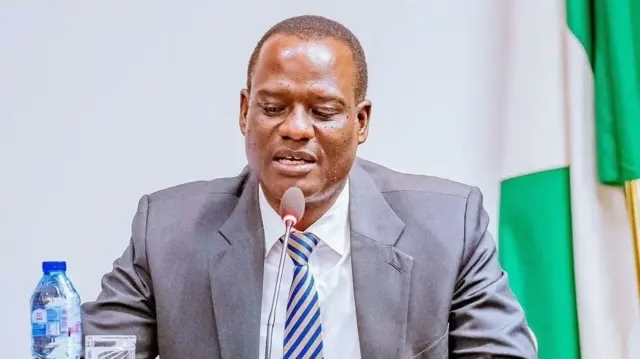
The Federal Ministry of Finance has dismissed claims that Nigeria is engaging in “hidden spending” or diverting federation revenue, describing such reports as a misinterpretation of findings from the latest Nigeria Development Update by the World Bank.
In an official statement, the ministry said recent media reports and commentaries have inaccurately portrayed key aspects of the report, particularly regarding deductions from the Federation Account Allocation Committee (FAAC).
The statement, signed by the Minister of State for Finance, Taiwo Oyedele, stressed that FAAC deductions are legitimate fiscal transactions and not evidence of waste or missing funds.
FAAC Deductions Not ‘Waste’
According to the ministry, FAAC deductions referenced in the World Bank report cover several statutory and essential expenditures, including transfers, investments, security spending, and cost-of-collection charges.
It explained that refunds to Ministries, Departments, and Agencies (MDAs), as well as transfers to state and local governments, are lawful financial flows backed by existing fiscal frameworks.
“These are not leakages but legitimate obligations and statutory allocations,” the statement noted.
Misuse of Data Criticised
The ministry also accused some commentators of relying on outdated data while ignoring ongoing reforms highlighted in the report.
It pointed to recent policy measures, including an executive order aimed at improving remittance of petroleum revenues, which the World Bank says could boost government earnings and transparency.
The reforms are expected to increase distributable revenue by approximately 0.4 percent of GDP annually, according to the report.
Positive Economic Outlook Highlighted
Contrary to claims of fiscal mismanagement, the ministry said the World Bank report presents a broadly positive outlook on Nigeria’s economy.
Key highlights include:
- More diversified economic growth across sectors
- Gradual decline in inflation due to policy interventions
- Strengthened external reserves and current account surplus
- Improvement in debt indicators, including a reduction in the debt-to-GDP ratio
The government attributed these gains to ongoing macroeconomic reforms under President Bola Ahmed Tinubu’s administration.
The ministry emphasised that the World Bank did not conclude that Nigeria’s fiscal system is failing, but rather encouraged the continuation and deepening of reforms.
It urged media organisations and stakeholders to ensure accurate interpretation of fiscal data to avoid misinformation that could undermine public confidence.
“The Federal Government remains committed to fiscal transparency, improved revenue mobilisation, and efficient public spending,” the statement added.
Follow BONA NAIJA for more