News
Blood Moon: Partial Lunar Eclipse to Light Up African Skies Friday — NASA

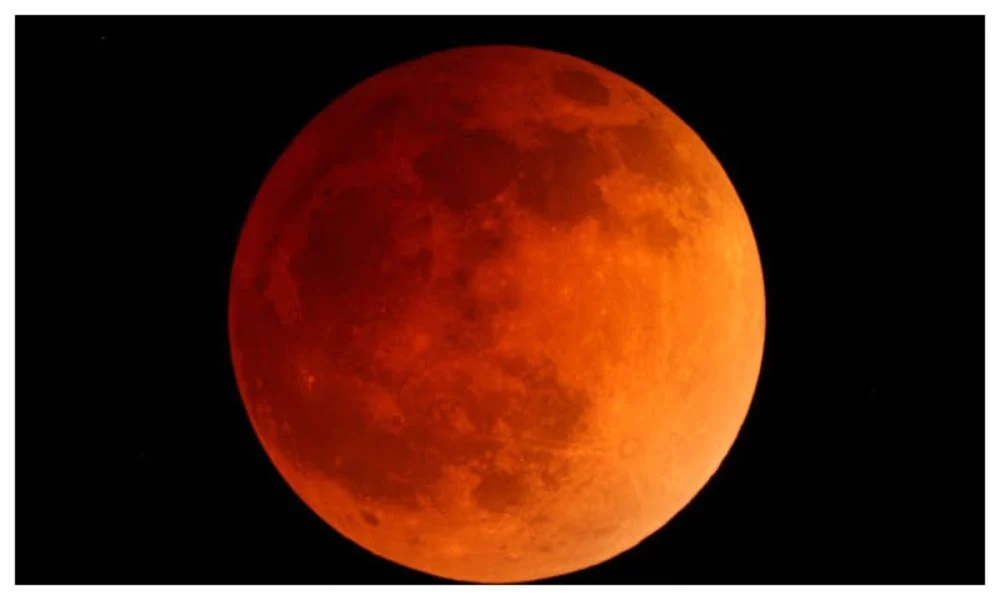
Skywatchers across parts of Africa, Europe and the Americas are set to witness a striking partial lunar eclipse on Friday, August 28, 2026, as the Moon passes through Earth’s shadow.
NASA has confirmed that the event will be visible across parts of Africa, Europe, the Americas and the Pacific, with the eclipse occurring during the night of August 27 and into August 28 depending on location and time zone.
The phenomenon, commonly associated with the term “blood moon” because the Moon can take on a reddish or coppery appearance, will be a deep partial lunar eclipse rather than a total lunar eclipse.
According to NASA’s Scientific Visualization Studio, the eclipse will reach its greatest point at 4:13 a.m. Universal Time (UTC), when approximately 96.3 per cent of the Moon’s disk will be inside Earth’s dark central shadow, or umbra.
When will the eclipse happen?
NASA’s astronomical calculations show that the partial lunar eclipse occurs on August 28, 2026, although observers in some parts of the world will see it begin on the evening of August 27.
The Moon will first pass through Earth’s outer shadow before moving deeper into the umbra. NASA says the partial phase begins at approximately 2:34 UTC, equivalent to 10:34 p.m. Eastern Time on August 27.
The eclipse will reach its maximum at about 4:13 a.m. UTC, when 96.3 per cent of the Moon’s disk will be within the umbra.
NASA’s broader eclipse information gives the maximum at approximately 12:13 a.m. Eastern Daylight Time.
The entire lunar eclipse, including the penumbral phases, lasts several hours.
Why is it called a Blood Moon?
A lunar eclipse occurs when the Earth moves between the Sun and the Moon, causing Earth’s shadow to fall across the lunar surface.
During a partial lunar eclipse, only part of the Moon enters the darkest section of Earth’s shadow.
The Moon can appear reddish or orange because sunlight passing through Earth’s atmosphere is filtered before reaching the lunar surface. Blue light is scattered more easily, while longer red and orange wavelengths are more likely to pass through the atmosphere and illuminate the Moon.
This is the same basic atmospheric effect responsible for the reddish colours often seen during sunsets.
Africa among regions able to see the eclipse
NASA lists Africa, Europe, the Americas and parts of the Pacific among the regions where the August 2026 partial lunar eclipse will be visible.
However, visibility and the amount of the eclipse seen will vary considerably depending on the observer’s location.
For some locations, the Moon may be close to the horizon or the eclipse may occur partly after moonset, meaning observers could see only part of the event.
In western Africa, the eclipse will be visible during the early morning hours of August 28 in many locations.
What will the Moon look like?
The Moon will not completely disappear because this is a partial, rather than total, lunar eclipse.
Instead, Earth’s dark shadow will gradually move across the lunar disk, creating the appearance of a large dark “bite” taken from the Moon.
At maximum eclipse, only a small portion of the Moon will remain outside the umbra, while the eclipsed portion can develop a coppery or reddish colour. NASA describes the August event as a deep partial lunar eclipse.
NASA’s August skywatching guide says about 93 per cent of the Moon’s diameter will be inside Earth’s umbra at maximum eclipse, while the corresponding area of the Moon’s disk within the umbra is about 96.3 per cent.
Is it safe to watch?
Yes.
Unlike a solar eclipse, a lunar eclipse is safe to view directly with the naked eye. No special protective glasses are required.
NASA says binoculars or a small telescope can also be used to get a closer view of Earth’s curved shadow moving across the Moon.
Skywatchers should ideally find an area with a clear view of the sky and limited artificial lighting. Cloud cover, weather conditions and the Moon’s position above the horizon will determine how clearly the eclipse can be observed.
Another major eclipse in 2026
The August lunar eclipse comes just weeks after a major total solar eclipse on August 12, 2026, which was visible along a path crossing parts of Greenland, Iceland, Spain and Russia, with a partial solar eclipse visible across wider areas including Africa and Europe.
NASA’s eclipse catalogue lists four eclipses in 2026: two solar eclipses and two lunar eclipses. The August 28 event is the year’s second lunar eclipse and is classified as partial.
For skywatchers, Friday’s event provides another opportunity to observe one of nature’s most dramatic celestial displays as Earth’s shadow slowly sweeps across the face of the full Moon.
Follow BONA NAIJA for more