
Feature
Nigeria Free Trade Zone At 30: Milestones and Prospects for Inclusive Industrialisation

By Martins Odeh/Golda Ukomadu,
The decision of our past governments leading to the adoption of the Free Trade Zones Scheme, a global economic model to aid widespread economic growth on November 30, 1992 has to this moment remained a legendary step toward fast tracking the country’s industrialization.
The operation of the free trade zones is deliberately incentivized to stimulate Foreign Direct Investments (FDIs); Domestic Direct Investments (DDIs); employment generation; infrastructure development; technology transfer; skill transfer to boost the country prosperity profile.

The scheme was first adopted through the enactment of the Nigeria Export Processing Zones Authority (NEPZA) Act 63 of 1992 and this gave the Authority the mandate to license and administer the scheme in a manner to fast track economic growth and industrialization.
The scope of the model was thoughtfully widened with the enactment of the Oil and Gas Free Zones Act, CAP 05 Laws of the Federation of Nigeria, 2004), specifically bestowed with the mandate to license, regulate and administer investments in the oil and gas free zones in Nigeria.
These two regulatory agencies have kept to their mandates in a way that they have continued to spew the fortunes of the scheme for the growth of the economy.
The country may not have reaped bountifully from the scheme within the last 30 years, but the scheme has shown flashes of successes and achievements in providing backward linkages to the various production value chains in Nigeria,.
Also, it can be seen that further milestones have been reached as a result of President Muhammadu Buhari’s unflinching commitment and support for the development of the scheme in the past seven years.
The government’s involvement in the promotion of the operations of the zones has led to the upsurge of interests of both zone owners, and enterprises alike to continually leverage on the country’s huge market to boost their profits exponentially.
For instance, NEPZA now manages 44 private and two public free trade zones with 625 enterprises providing 150,000 direct jobs and estimated 250,000 indirect jobs with total investment put at 26 billion-US-dollars.
In like manner, the Oil and Gas Free Zones which have become growth centres that compliment government’s efforts by enhancing job creation, have significantly contributed to the country’s GDP through the multiplier effect of its activities.
Since inception to date, OGFZA has attracted over 30 billion-US-dollars of FDI into the country. It has also created over 50,000 direct jobs and an estimated 160,000 indirect jobs. Furthermore, it has also attracted over 185 foreign and local companies to its controlled zones.
In addition, local capital investment in the free zones stands at N255.33 billion, facilitating both physical and economic developments in the locations of its free zones with 103 functional companies from 45 countries operating in the zones.
Culminatively, the scheme as at 2021 has so far generated about 620 billion naira of Domestic Direct Investments (DDIs) and 66 billion-US-dollars worth of Foreign Direct Investments.
It is therefore, important to state that the scheme, even with its unparalleled incentives that appear to be like a comprehensive tax holidays, remains a major lubricant of the Nigeria’s economy in all ramification.
The concept is beginning to make a lot more meaning as both NEPZA and OGFZA have resolved to seamlessly interpret government’s vision on using variant free zones to revamp the nation’s economy in a more expeditious manner.
Permit me, therefore, to draw an inference from one of the founding Directors of World Export Processing Zones Association (WEPZA), Richard Bolin, who said in 1988 conference in Flagstaff, Arizona USA, that “Free Zones were not going to disappear, but that they could only undergo changes.’’ This is, however, coming through with the diversification and multiplication of unique zones based on the services they offer.
As can be seen, both NEPZA and OGFZA have continued to seamlessly interpret president’s vision on revamping the economy using the Special Economic Zones (SEZs), a free zone variant that allows for the licesing of specialized zones.
It will not be out of place to, therefore, commend this administration that has taken lofty steps to indeed begin genuine revamping of the economy by approving six new of those variant zones that will eventually obliterate the ugly tales of the country just being able to set up only two public free trade zones in almost 30 years.
These new special economic zones under NEPZA control are the Medical/Pharmaceutical SEZ Lekki, Agro-Allied SEZ Ilorin, and the Integrated Cotton/Textile/Garment SEZ Funtua, Katsina. The three others are to be located in Benue, Gombe and Ebonyi states respectively.
The federal government along similar thought earmarked the Murtala Muhammed International Airport, Lagos; Nnamdi Azikiwe International Airport, Abuja; Port/Harcourt International Airport as well as the Aminu Kano International Airport, Kano; as Free Trade Zones to be managed by NEPZA.
This pragmatic approach of the government to widen the horizon of the scheme is a testament to the president’s vision to more than ever before use this global business corridor to generate employment, attract both FDIs, and DDIs, and to further envigorate the building of a production-based economy for sustainable growth.
No doubt, the scheme holds greater prospects for our nation as it provides us the latitude to operate it in such a manner to have far-reaching positive impacts on the government and citizenry.
There is no gainsaying that the Lekki Deep Sea Port, a marquee project, at the Lagos Free Zone, that has been completed will have a huge positive impact on the Nigerian economy.
It has the capacity to contribute significantly in boosting the economy and to also bring about the desired global competition in the country’s shipping, logistics and all associated businesses.
The project which sits on 90 hectares of land and promoted by the Tolaram Group based in Singapore, the Nigerian Ports Authority (NPA) Lagos State Government and China Harbour Engineering Company (CHEC) is projected to generate over 170, 000 direct and indirect jobs.
Also located at the Lekki business axis, is the Dangote Free Zone Enterprise harbouring a world class multi-billion-naira Refinery touted to be the world’s biggest single-train facility aimed at reducing the country’s oil importation and saving government’s billions of dollars from importation.
It will not only provide over 70,000 direct and indirect jobs, but will remove the stigma of an oil producing country that is now compelled to import refined petroleum products for domestic use.
The Lekki corridor, which equally warehouses the Lekki Free Trade Zone and Alaro City plus other zones within the supervision of NEPZA including Ogunguandong, in Ogun State, Eko Atlantic City, LADOL Free Trade Zone, Enyimba City Free Trade Zone, are ostensibly national assets with capacity to unlock the country’s economic potentials.
So, you can see from the progress made, it isn’t just a wish for us to drive the nation’s economy using this scheme, but that the present administration has backed such wish by taking action to raise the ante in its funding, policy support and effective management of the scheme.
It is again important to state that the scheme, even with its unparalleled incentives that appear like a comprehensive tax holiday still remains the Nigeria’s economic fulcrum.
After all, the overall objective for the adoption of the scheme is to create an enabling environment for export-oriented manufacturing in both the oil and non-oil sectors of the economy, a role it is currently playing very well in spite of some avoidable challenges.
It is, therefore, incontrovertible to aver that the federal government has within the last 30 years benefited enormously from the free zone operations through the consistent inflow of FDIs; DDIs, employment; foreign exchange earnings; technology transfer; and special skills transfer as earlier mentioned.
Interestingly, the prospect of the country’s 30 years free zone is further brightened by the country signing off to the Africa Continental Free Trade Act (AfCFTA) in 2020. It is a new business and trade agreement with 54 African countries merging into a single market of 1.3 billion people.
This agreement, with the merit of enhancing sustainable markets, will create an economic bloc with a combined GDP of $3.4 trillion-dollars while generating a combined consumer and business spending of $6.7 trillion-dollars by 2030.
Nigeria is, therefore, focused on using a variety of its economic frontiers, including the free zone to leverage on this agreement to expand its trading routes across the continent.
To this end, NEPZA and OGFZA are beginning to activate their individual action plans to ensure that the country’s free zone lead the citizens to economic prosperity going forward.
This resolve is already being displayed by Prof. Adesoji Adesugba, the NEPZA’s Managing Director/CEO, who shows no hesitation in drawing more investments into the Authority’s free zone net having recently agreed to a partnership deal with Binance and Talent City to float the first Virtual Free Trade Zone in Africa. The Authority is seeking to use this new brand zone to break new grounds to widen the country’s economic opportunities.
The NEPZA’s boss’ singular goal is to engender a flourishing virtual free trade zone that will take advantage of the near $1 trillion-dollars virtual economy in blockchains and digital economy.
Adesugba’s performance and achievements within just two years as helmsman of the Authority are too numerous and commendable and these accomplishments occured because of his firm focus and knowledge of the free zone concept.
This thoroughbred investment promoter has also recently encouraged the licensing of the Hydropolis Free Trade Zone in Kainji, Niger State where an initial capital of 1 billion-US-dollars shall be committed to its development.
The zone, described as first of its kind in the North Central region, shall be a replica of the Lekki industrial corridor. The positive impact this multi-billion-dollar business ecosystem will bring on the economic and social life of the people can only be imagined.
In a similar vein, OGFZA has made an enormous impact on the development and economic growth of the country since its inception in 1996.
Basically, its vision is to be that premier agency of government responsible for promoting, securing and sustaining investments in the nation’s oil and gas free zone.
On the other hand, the Authority has the mission to facilitate public-private partnership investments as a vehicle for promoting accelerated growth and development.
So far, OGFZA has grown the number of its free zones and volume of investments by licensing more investors and new oil and gas free zones namely:
• Onne/Ikpokiri Oil and Gas Free Zone, Onne, Rivers State, 1996
• Warri Oil and Gas Free Zone, Warri Port, Delta State, 2011
• Brass Oil and Gas City, Brass Island, Bayelsa State, 2015
• Eko Support Services Oil and Gas Free Zone, Apapa Port, Lagos State, 2015
• Notore Industrial City, Onne, Rivers State, 2018
• Liberty Oil and Gas Free Zone, Akwa Ibom State, 2020
• Bestaf Maritime Industrial Oil and Gas Free Zone, Kirikiri, Lagos State, 2022.
Today, OGFZA boasts of having the largest Oil and Gas Free Zone in Africa. It has in its profile, the Liberty Oil and Gas Free Zone, located in Akwa Ibom State with 50, 216 hectares cutting across six local government areas. Also, OGFZA’s flagship Oil and Gas Free Zone Onne in Rivers State has been adjudged the “Most successful free zone in the world.’’
The Oil and Gas Free Zones (OGFZs) have helped to deepen the economy of Nigeria by providing specialized regulatory supervision and services, thereby repositioning the country as a leading player in oil and gas activities in Africa and have attracted major International Oil Companies (IOCs) who use the free zones as hubs for their business transactions covering the entire Gulf of Guinea to Southern Africa.
From the above, one can see how OGFZA has also ensured that enterprises under its supervision continued to lubricate the country’s economic wheel.
For instance, as at 2015, investment inflow into the free zone represented 65.5 per cent of total investment of the nation. Little wonder the agency has its cabinet filled with local and international awards such as Specialism Award, Bespoke Incentives and Large Tenant Awards from 2017 to 2022. These are all fDi awards, a Magazine of the Financial Times of London.
In 2019, OGFZA also received the Award of Excellence in Productivity and Innovation in e-government from the National Productivity Centre. This year, OGFZA again, emerged tops alongside two other agencies on the PEBEC’s Ease of Doing Business ranking crowned as the most efficient agency of government; a feat the Authority has maintained these past years.
To further propel the Authority to deliver more, the president in July appointed Sen. Tijjani Kaura, MFR; as its Managing Director/CEO to succeed Chief Umana Okon Umana, now Minister of Niger Delta Affairs. Kaura has told everyone who cares to listen that his tenure would be to grow the inflow of investments in a torrential manner with strict focus on corporate governance, transparency, accountability and due process.
In conclusion, it is alright for these two agencies to roll out the drums to celebrate, but whilst doing so, the government and other vital collaborative agencies helping to nurture the scheme should brace up to eliminate all superfluous tendencies preventing the country from realizing the full potentials of this global business concept.






The Nigerian Bar Association is concerned about reports of an incident that occurred on Monday, 16 March 2026, at the Federal High Court, Abuja, involving Honourable Justice Mohammed Umar and a legal practitioner, Mr. Marshall Abubakar, who appeared as lead defence counsel to Mr. Omoyele Sowore @sowore. According to reports, the learned trial judge, in response to counsel raising his voice while addressing the court on the suitability of a hearing date, directed the lawyer to step out of the Bar and kneel down, alongside issuing threats of committal for contempt.
The NBA views this development with utmost seriousness, given its implications for the dignity of the legal profession and the sanctity of the courtroom.
The courtroom is a temple of justice, governed by law, procedure, and decorum. While judges are vested with the authority to maintain order and discipline in their courts, such authority must be exercised strictly within the bounds of the law and established judicial standards. The power to punish for contempt is well recognised; however, it is circumscribed by defined legal procedures designed to ensure fairness, objectivity, and respect for the rights and dignity of all persons appearing before the court.
A judex directing a legal practitioner or indeed any person whatsoever to kneel in court is not a recognised judicial sanction under our laws and does not align with the standards of judicial conduct expected on the Bench. The dignity of the court must be preserved not only in outcome but also in process, and this includes the manner in which judicial authority is exercised. If a judge is of the view that a person has acted in a manner that is contemptuous of the court, the judge MUST follow the accepted way of conducting proceedings for such allegations.
We reiterate that legal practitioners bear a corresponding duty to conduct themselves with restraint, professionalism, and respect for the court at all times. While lawyers are entitled, indeed obligated, to advocate firmly and fearlessly on behalf of their clients, such advocacy must always be exercised within the bounds of courtesy and decorum. Disagreements with the court, no matter how strongly felt, must be expressed through proper legal channels and not in a manner that disrupts proceedings or undermines the authority of the court.
The legal profession thrives on a delicate but essential balance, one rooted in mutual respect between the Bar and the Bench. This relationship is fundamental to the administration of justice and must be jealously guarded.
The NBA calls for calm and restraint on all sides and urges that any grievances arising from courtroom incidents be addressed through appropriate institutional and disciplinary mechanisms. Where necessary, the Association will engage with relevant authorities to ensure that the rule of law, professional standards, and judicial ethics are upheld.
Mazi Afam Osigwe, SAN
President, Nigerian Bar Association
Follow BONA NAIJA for more

Fresh details have emerged surrounding the death of fast-rising gospel singer Ifunanya Nwangene, popularly known as Nanyah, who died at the Federal Medical Centre (FMC), Abuja, following a snake bite.
Since her passing, the tragic incident has generated widespread speculation and emotional reactions within the gospel music community and beyond. However, emerging accounts now suggest that inadequate availability of anti-venom at FMC Abuja may have contributed to her death.
Investigations revealed that at the time Ifunanya was admitted, the hospital reportedly had only one dose of anti-venom, which was administered to her. Efforts to procure an additional dose were underway, but she reportedly died before it arrived.
Delay in Getting to Hospital
Speaking to Advent Cable Network Nigeria, the coordinator of the choral group Ifunanya belonged to, identified as Mr Ezugwu, narrated events from the moment of the incident to her death according to NationalPost Report.
According to him, the singer initially struggled to get immediate transportation to the hospital as a neighbour’s car failed to start. He said she ran approximately 500 metres from her estate to the gate, where she eventually boarded a commercial motorcycle (okada) to a nearby hospital before being transferred to FMC Abuja.
Mr Ezugwu noted that medical opinion later suggested that excessive physical exertion after a snake bite could accelerate the spread of venom in the body.
Emergency Efforts at FMC Abuja
He disclosed that on January 31, around 10:13 a.m., an urgent message was posted on their group’s platform asking who was close to Jabi or FMC Abuja. Shortly after, it was confirmed that Ifunanya had been bitten by a snake and taken to FMC.
Upon arrival at the hospital, Mr Ezugwu said Ifunanya was placed on oxygen and intravenous drips, and doctors administered the last available dose of anti-venom in the hospital’s pharmacy.
Doctors reportedly requested a specific type of anti-venom that was unavailable at FMC, directing relatives to obtain it from a pharmacy near the National Hospital, Abuja.
While efforts were made to purchase the medication, her condition deteriorated.
“At a point, she became unusually still. Though doctors were checking her vital signs, my instinct told me something was wrong,” Ezugwu recounted.
While returning with the anti-venom, they received a call confirming that resuscitation efforts had failed and that Ifunanya had passed on.
Family and Aftermath
Her lifeless body was later seen in the emergency ward, prompting emotional scenes as colleagues and sympathisers gathered, praying for several minutes without response.
Ezugwu revealed that Ifunanya’s father was eventually contacted and requested that her body be conveyed to Enugu State for burial arrangements.
Possible Contributing Factors
According to Mr Ezugwu, two major factors may have contributed to the singer’s death:
- Delay in getting immediate transport to a medical facility
- Insufficient supply of anti-venom at FMC Abuja
Medical feedback reportedly indicated that Ifunanya should have been in a stable condition if treatment had been administered promptly and adequately.
Her death has reignited conversations around emergency medical preparedness, availability of life-saving drugs, and healthcare response capacity in Nigeria’s public hospitals.
Federal Hospital Jabi Speaks Out On Abuja Singer Nanyah’s Death, Denies Claims Anti-Venom Was Unavailable
The Federal Medical Centre (FMC), Jabi, has issued a formal clarification following widespread public discussion surrounding the death of Abuja-based singer Ifunanya Lucy Nwagene, who died after complications from a snake bite.
In a press statement on X, dated February 1, 2026, the hospital expressed condolences to Nwagene’s family and sought to address claims circulating on social media regarding the circumstances of her treatment and death.
The statement read, “Federal Medical Centre, Jabi has issued a press statement clarifying recent events surrounding the tragic passing of Late Ifunanya Lucy Nwagene following complications from a snake bite.
“We extend our deepest condolences to the family and loved ones affected by this loss. FMC Jabi reaffirms its commitment to quality, timely, and life-saving care, and encourages the public to rely on verified information from credible sources.
“We wish to address the circulating discussion on social media concerning the unfortunate case of Ms. Ifunanya Lucy Nwagene, who tragically passed away due to neurotoxic complications following a snake bite on January 31, 2026.
“First and foremost, we express our deepest condolences to the Nwagene family during this incredibly difficult time. The loss of a loved one is never easy, and our thoughts are with them.
“We want to clarify that the management team at Federal Medical Centre, Abuja acted promptly and with the utmost care upon Ms. Nwagene’s arrival. Our medical staff provided immediate and appropriate treatment, including resuscitation efforts, intravenous fluids, intranasal oxygen, and the administration of polyvalent snake antivenom.
“After a thorough but quick evaluation, it was clear that Ms. Nwagene suffered severe neurotoxic complications from the snake bite. Despite all efforts to stabilise her condition and transfer her to the Intensive Care Unit for further treatment, she experienced a sudden deterioration just before the transfer. Our team of professionals worked diligently to provide CPR and other life-saving measures; however, despite these efforts, we were unable to revive her.
“We stand by the quality of care and dedication our team demonstrates daily. The claims of non-availability of anti-snake venom and inadequate response are unfounded and do not reflect the reality of the situation. We are committed to transparency and integrity in our practices and will continue to pursue excellence in patient care.
“In light of these events, we encourage our community to engage with credible sources for information and updates rather than relying on social media speculation. We remain available for any further inquiries or clarifications. Thank you for your understanding.”
The statement was signed by Dr Bioku Muftau, Head of Clinical Services at Federal Medical Centre, Jabi.
Ggospel singer Ifunanya Nwangene, popularly known as Nanyah
Ifunanya Nwangene, appeared on Season 3 of “The Voice Nigeria”. Nwangene first gained national attention on “The Voice Nigeria” after turning two judges’ chairs with her rendition of Rihanna’s “Take a Bow.” The audition video has since pulled in more than 80,000 views on YouTube.
At the time of her death, she was planning her first solo concert for 2026.
Ifunanya was 26.
RIP.
Follow BONA NAIJA for more

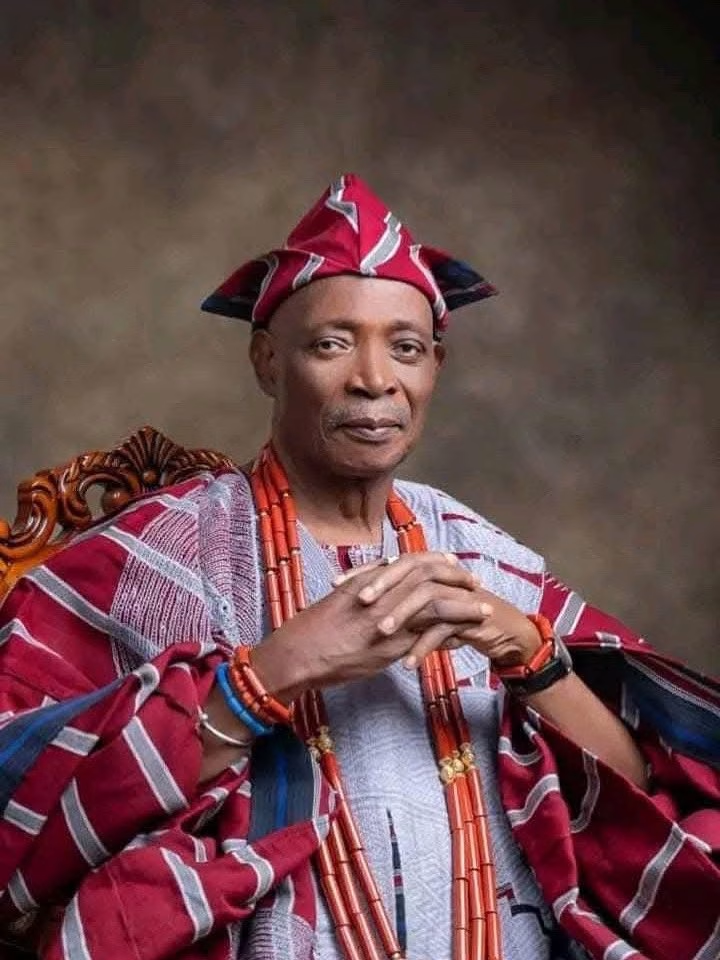
The odyssey of Senator Rashidi Adewolu Ladoja to the ancestral throne of Ibadan is not only historic but profoundly political, laced with trials and triumphs.
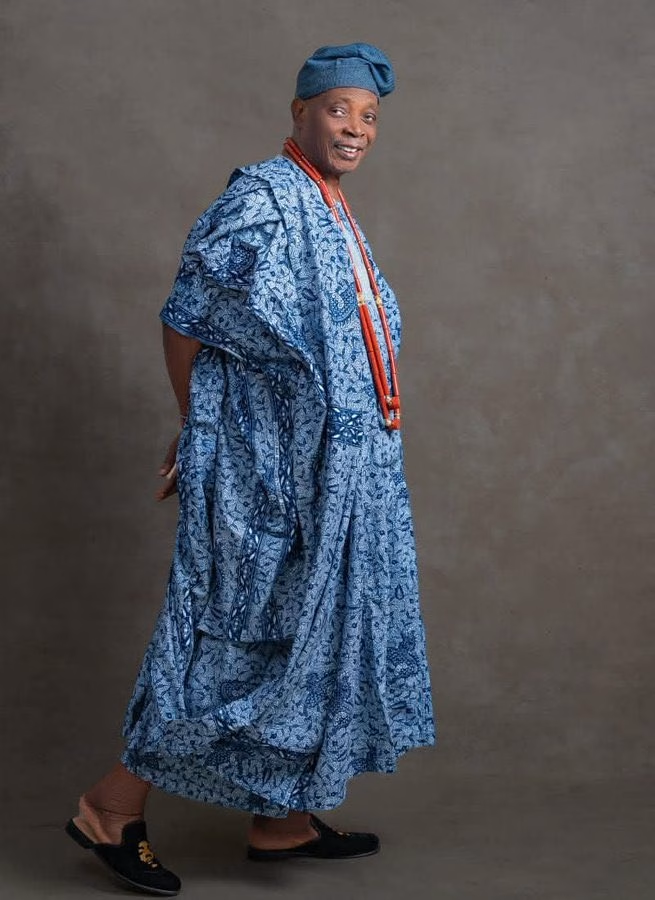
History often unfolds slowly, like a scroll revealing one line at a time. In Ibadan, a city steeped in tradition and resilience, history has once again taken a defining turn.
Oba Rashidi Adewolu Ladoja, former governor of Oyo State, businessman, politician, and activist, is now preparing to ascend the exalted throne as the 44th Olubadan of Ibadanland.
His decades-long journey, filled with trials, victories, and service, tells a compelling story of destiny, courage, and legacy. From political powerhouses to royal lineage, from boardrooms to the battlefields of democracy, Ladoja’s life blends tradition with transformation. His ascension is not only personal fulfilment but also a cultural and historical moment for Ibadanland.
Indeed, his coronation stands as a milestone, a testament to resilience, faith, and destiny fulfilled. On September 26, 2025, Oba Ladoja will be crowned the 44th Olubadan of Ibadanland, closing a circle that began 34 years ago when he became Mogaji of his family compound in Isale-Osi. But this is no ordinary coronation; it is the culmination of a saga defined by ambition, resistance, exile, betrayal, resilience, and ultimately, triumph.
Road to Royalty: From Mogaji to Monarch
It began in 1991 when Rashidi Ladoja became Mogaji (family head) of the Arusa compound in Isale Osi, a deeply rooted quarter in Ibadan South-West Local Government Area. That symbolic beginning marked the first step on Ibadan’s rigorous 36-step chieftaincy ladder, reserved for those destined to wear the revered crown.
The Ibadan succession system is unique among Yoruba kingdoms. Unlike other traditional stools where royal families are narrowed to specific lineages, the Olubadan system is remarkably open and transparent. Two lines of succession, the civil (Otun) and the military (Balogun), run concurrently, and candidates rise step by step until the next in line becomes Olubadan. It is an orderly system that rewards longevity, patience, and service, making the throne one of the most respected in Yorubaland.
On October 1, 1993, Ladoja was installed as Jagun Balogun Olubadan, formally entering the military line of succession. Over the next 31 years, he advanced steadily, surviving political turbulence, personal setbacks, and traditional disputes. Few endure the politically charged and physically demanding journey to the top, but Senator Ladoja did — with grit, patience, and determination.
“I never imagined destiny would call me to the throne at this time. It’s been one of patience, perseverance, and grace,” Oba Ladoja told a gathering at his Bodija residence after his official nomination.
Political Elite Meets Royal Heritage
In a city of warriors and statesmen, Oba Ladoja is the first former governor and senator to become Olubadan.
Trained as a chemical engineer in Belgium, he made his mark in oil, shipping, banking, agriculture, and transport before rising as a political force.
During the short-lived Third Republic, he was elected senator on the platform of the defunct Social Democratic Party (SDP). In 2003, he defeated incumbent Lam Adesina to become Governor of Oyo State on the platform of the Peoples Democratic Party (PDP).
Two years later, he was impeached in what many described as a conspiracy driven by then-President Olusegun Obasanjo and political strongman, Lamidi Adedibu. His reinstatement by the Supreme Court after 11 months in exile was more than a legal victory — it was a political resurrection. It cemented his reputation as “the indomitable warrior”, a man political opponents could not erase or ignore.
That resilience, combined with patient navigation of Ibadan’s chieftaincy system, has now borne fruit.
“It has been a bumpy journey filled with trials, but only made possible by the grace of God,” he told jubilant supporters.
Defiance and Reconciliation
Ladoja’s political career was often defined by principles that put him at odds with powerful figures.
In 2018, when then-Governor Abiola Ajimobi crowned Ibadan High Chiefs as kings, Ladoja stood alone in defiance. He rejected what he called a “carton-paper-made” beaded crown, declaring that the only crown worthy of him was the Olubadan’s. His refusal sparked years of political and legal confrontation.
“Why should I wear a crown not recognised by tradition?” he asked. “The throne is not for the desperate.”
Yet, in August 2024, in a radio interview, he softened his stance, saying unity was more important than pride: “The voice of the people is the voice of God. I am ready to accept the beaded crown if it will bring peace and allow me to serve the people of Ibadan.”
That statement shifted the atmosphere. His colleagues in the Olubadan-in-Council rallied behind him, and he was soon unanimously nominated and approved by Governor Seyi Makinde as the 44th Olubadan.
Unlike his clashes with Ajimobi, Ladoja’s relationship with Governor Makinde has been cordial and strategic. Makinde’s prompt approval of his nomination reflected a convergence of political and traditional power, a necessity in Oyo State where the Olubadan stool carries both cultural influence and political weight.
The Crown and the City
Ibadan is no ordinary city. It is the largest traditional Yoruba urban centre and the historic political capital of the old Western Region. The Olubadan, though largely symbolic, wields influence over millions.
For Oba Ladoja, this reign is not ceremonial. It is an opportunity to redefine the stool, blending cultural authority with political wisdom.
“I pray that my reign shall bring peace, prosperity, and progress to Ibadanland,” he said, calling for unity.
Expectations are high. From Oke Aremo to Abuja, all eyes are on him to redefine the modern monarch’s role not just custodian of rituals, but guardian of peace, diplomacy, and security. He has already urged coordinated efforts to secure Ibadan and Yorubaland amid rising insecurity.
The coronation of Oba Ladoja is more than a local event; it is a national stage. Expected guests include President Bola Tinubu, former Vice President Atiku Abubakar, Senator Rabiu Kwankwaso, former governors, business moguls, activists, and traditional rulers across Yorubaland and beyond.
Their presence underlines the symbolic place of Ibadan in Yoruba and Nigerian politics.
Activism, Sacrifice, and Legacy
Ladoja’s story is not just about royalty; it is about activism and identity. As a NADECO stalwart, he stood against military rule in the 1990s, supporting the pro-democracy struggle after the annulment of the June 12 election.
Chief Adeniyi Akintola (SAN) recalls: “We used his ships for NADECO’s activities after the Senate was dissolved. His businesses were seriously affected — he had a shipping line and the largest palm plantation in West Africa then.”
As governor, he challenged a sitting president. As High Chief, he resisted compromising tradition. As a businessman, he sacrificed fortune for democracy. Now, as Olubadan, he embodies the fusion of political power and cultural authority.
To former Nigerian Ambassador, Dr. Yemi Farounbi, “Ibadan is the intellectual capital of Nigeria. It provided security for the Yoruba in times of war. Peace must return, and the Olubadan must lead it.”
Professor Tunde Adeniran, a former minister, added: “He comes with experience and expansive networks. Expectations are high. We must rally around him.”
For younger Ibadan residents, his ascension represents continuity and hope. “We grew up hearing about his struggles as governor and his fight for justice,” said Akeem Alabi, a postgraduate student at the University of Ibadan. “Now he is our king. We expect him to stand for the people, just as he did in politics.”
The Crown After the Storm
For many, the crowning of Oba Rashidi Ladoja is poetic justice, a fitting epilogue to a life of battles in politics, business, and tradition.
From Mogaji in 1991 to Olubadan in 2025, from impeachment to reinstatement, from defiance to reconciliation, he now wears the crown not as a reward but as a responsibility.
The royal father is no longer just the “cat with nine lives”; he is the king whose destiny has come full circle.
Governor Seyi Makinde has expressed readiness to work seamlessly with Oba Ladoja towards the development of Ibadan city, describing the new monarch as an exemplary leader whose wealth of experience in politics, business, and community service will enrich the Olubadan stool.
Makinde recalled that his own political journey could not be written without Ladoja’s role, stressing that: “Baba remains a father figure whose guidance has shaped many of us. I hold him in high esteem, and I believe Ibadan and Oyo State will benefit from his reign as Olubadan.”
As Ibadan embraces this new chapter, the coronation of Oba Rashidi Adewolu Ladoja stands as both history and prophecy fulfilled a story of destiny, resilience, and triumph, written across the canvas of politics, tradition, and legacy.
CULLED FROM THE GUARDIAN
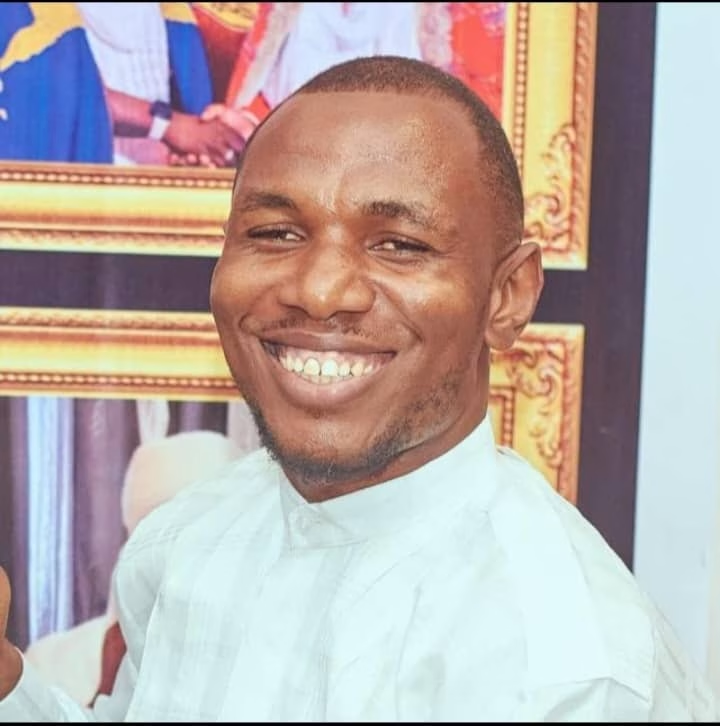
By Ima-owaji G. Shedrack
As the world commemorates the International Day of Peace, attention has once again shifted to the bold and inclusive policies of the Chairman of Andoni Local Government Area, Hon. Promise Lucky Otuo, whose leadership style has been described as a model for peacebuilding and sustainable development.
Since assuming office, Hon. Otuo has consistently emphasized that his government is a “no discrimination government,” a philosophy set to guide his policies and programs across the council.
In a remarkable demonstration of this principle, the Chairman extended empowerment opportunities not only to indigenes but also to non-indigenes residing and trading in Andoni. This inclusive approach, observers say, has deepened trust, fostered unity, and reduced the tensions that often arise from feelings of neglect or inequality.
Mr. Ima-owaji G. Shedrack, a stakeholder in the Renewed Hope family, applauded the initiative, noting that Hon. Otuo has shown that peace is not just about preventing conflict but also a conscious steps in building an environment where fairness and inclusiveness are at the center of governance.
“As Andoni joins the world to mark the International Day of Peace, Hon. Lucky Otuo’s leadership style that is anchored on ‘no discrimination’ is built to offer a clear roadmap, where peace is not only preached but practiced through deliberate policies of fairness and equal opportunity.”
Follow BONA NAIJA for more
Feature
Eid-ul-Mawlid: Uphold Hon. Lucky Otuo in your prayers, Ima-owaji Shedrack Urges non indigenes in ANOLGA

A stakeholder in Andoni Local Government Area of Rivers State, Ima-owaji Shedrack, has called on Muslim faithful in the area to remember the Chairman of Andoni LGA, Hon. Lucky Promise Otuo, in their prayers as they celebrate Eid-ul-Mawlid, the commemoration of the birth of Prophet Muhammad (SAW).
Speaking on Friday during the nationwide celebration, Ima-owaji stressed the importance of continuous prayers for leaders at all levels, describing Hon. Lucky Otuo’s administration as one that transcends sentiments, tribal lines, and religious differences.
“The government of Hon. Lucky Otuo is one beyond discrimination. Both indigenes and non-indigenes are carried along. This is why I urge our Muslim brothers and sisters to use this sacred celebration to pray for him and for the peace, progress, and prosperity of Andoni LGA,” Ima-owaji said.
He further noted that the Eid-ul-Mawlid celebration provides Muslims with another opportunity to renew their commitment to unity and inclusiveness, while also offering prayers for leaders who are steering the affairs of the people with sincerity.
Ima-owaji urged residents of Andoni, regardless of religion or origin, to embrace peace and support the development agenda of Hon. Otuo’s administration, which he said is focused on progress and inclusivity.
Follow BONA NAIJA for more

Shaibu Calls for Stronger Inter-Agency Collaboration as NIS Produces Nigeria’s First Certified Marathon Medical Director

Job Vancancy: Moniepoint Job Vacancies in Abuja and North Central Nigeria

Lookman Spotted in London Ahead of Arsenal vs Atletico UCL Showdown

2027 Bombshell: Ohanaeze Tells Peter Obi to Step Down for Tinubu

Burna Boy Splashes $100,000 on 6uff, Odumodublvck at Lagos Club Night

Nigerians Slam Moniepoint CEO Over ‘Talent Quality’ Remarks Amid Hiring Debate

Outrage as Soldier Assaults Journalist Over Traffic Dispute in Lagos

Outrage as DSS Arraigns Chidiebere Justice Mark Over Alleged Cybercrime, Military Incitement

Video: Fresh Blow to Obi–Kwankwaso Plan as Datti Questions Northern Backing ahead of 2027

PDP NEC Approves 13-Member Caretaker Committee Amid Internal Party Rift

News Flash: Court Suspends Secondus As PDP National Chairman, Member

2019 Presidency: Donald Duke’s Running Mate Quites Race Allegedly joins Atiku

Falana threaten to sue Kachikwu over $60bn oil revenue loss

#BONANAIJATV: Exclusive interview with OMPAN National President Comr Emeh James Anyalekwa #ompanowerri2018

Video : Phyno – Agu
Philippines president, Rodrigo Duterte brags about the size of his manhood

Video: Burna Boy – “Dangote”

VIDEO: Becca – Magic ft. Ycee

VIDEO: Patoranking x Davido – Confirm
TV personality Zainab Balogun reveals how she met her hubby and how his kids reaction when she told them she was going to be their new mum

Video: Screening of Former Governor of Kaduna State, Elrufai

OLISAE Rolls Out Video for New Song “SAMBELE” featuring Slowdog

Video: Dino Melaye mocks Tinubu during the PDP rally In Delta

Video: Shettima & I Will Not Abuse Each Other Like Obasanjo & Atiku – Bola Tinubu

Watch Sabinus’ Comedy on Tinubu, Peter Obi, other presidential candidates

Video: Buju feat. Burna Boy – Lenu (Remix)

VIDEO: Sammie Okposo – Nobody Can

VIDEO: Falz – Bop Daddy ft. Ms Banks

Watch Diane Russet’s Short Film “Bayi”

Video: Acoustic Performance of Patoranking’s “So Nice”


-

 Jobs3 weeks ago
ECOWAS Recruitment 2026: Massive Job Openings Across West Africa (Apply Now)
-
 Jobs3 weeks ago
Germany Embassy Abuja Announces Job Vacancy
-
 Jobs3 weeks ago
EU Invites Nigerian Graduates to Apply for 2026 Funded Traineeship in Abuja
-
 Jobs3 weeks ago
Research Interviewers Job: Jhpiego Hiring Across 36 States & FCT
-
 News3 weeks ago
Supreme Court Dismisses David Mark’s Application, Deepening ADC Leadership Crisis Ahead of 2027 Polls
-
 Music Video2 weeks ago
Fally Ipupa & Wizkid Ignite Charts with ‘JAM’ Video from XX Album
-
 News2 weeks ago
Captured Boko Haram Suspect Alleges Links to Senior Military Figure in Viral Interrogation Video
-
 Politics2 weeks ago
2027: Obi, Kwankwaso Supporters Launch ‘OK Movement’ Ahead of ADC Presidential Primary
-

 Events3 weeks ago
Emiralty Africa to Host ‘Emiralty Connect 1.0’ Summit in Lagos
-
 Politics3 weeks ago
ADC National Convention: Security Beefed Up as 3,000 Delegates Elect New NWC