
News
How ‘ghosts’ May Decide Nigeria’s 2023 Elections – Odinkalu


When it eventually occurred on February 23, 2019, Nigeria’s presidential election was not without suspense. North-East Nigeria, home to a counter-civilisational insurgency for over a decade, was a natural location for incidents. In 2019, it did not disappoint a country in which the things that could happen in elections often defied both logic and the laws of physics.
Geidam is a settlement about 240 kilometres East of Damaturu, the capital of Yobe State in the North-East. In 2019, the term-limited governor of the state, Ibrahim Geidam, derived his surname from the city around which he was registered to vote. On the day, however, Geidam suffered an attack from insurgents, which involved improvised explosive devices. On the same day also, less than 30 kilometres from Damaturu, in Gujba Local Government Area, the insurgents also attacked Buni Yadi, the settlement in which they destroyed a leading public high school five years earlier and massacred an unspoken number of school children.
As a result of the attacks, multiple observers on the day reported that “voting turnout appeared to be light as authorities tried to calm panicked, skeptical residents.” The attack was so serious that “Governor Geidam did not travel to his Bukarti ward near Geidam town 230 kilometres away from the state capital to cast his vote.”
When the votes were in, the national turnout in 2019 was 34.75%. It would have been much worse but for places like Geidam, Yobe State, and the states of the North-East, which recorded an average regional turnout of just under 42%.

Despite the insurgency and the attacks, Geidam helped Yobe State to muster a reported voter turnout of 42.9% in 2019, only marginally lower than the 43.9% in Adamawa, the home state of Atiku Abubakar, presidential candidate of the opposition Peoples Democratic Party, and 43.3% in Bauchi State. The turnout in Yobe was easily higher than in its more peaceful regional neighbours: Borno, 41.2%; Gombe, 41.9%; and Taraba, 41.7%. It also compared favorably with 45.6% in 2015 and 44% in 2011. Essentially, over three cycles of elections in one decade of a deepening insurgency, the turnout in Yobe State was nearly a constant.
By comparison, in the states of South-West of Nigeria, which did not have any exposure to large-scale violence like the North-East, the turnout in 2019 was Ekiti, 43.7%; Lagos, 18.3%; Ogun, 25.9%; Ondo 32.4%; Osun, 43.7%; and Oyo 31.9%.
This data presents a conundrum for those interested in understanding the correlation between structural insecurity and the exercise of the right to vote or voter participation. Contrary to the intuition that an insurgency or an election day atrocity would dampen voter turnout, academic, Olalekan Adigun, who has analysed the historical turnout data from the Independent National Electoral Commission, since 1999, concludes that “there is a negative correlation between election-related pre-election violence and the turnouts in Nigeria.”
So, rising violence has not necessarily affected the number of votes declared by INEC in most elections. His study also shows that situational violence may, however, have been used as a mechanism of voter suppression in places or against communities that powerful incumbents believed to be unfriendly. This appeared to have occurred in 2019.
Unlike in the past, however, INEC has now acknowledged that chronic insecurity which now afflicts every geo-political zone in the country, is a major threat to the 2023 elections. The ballot will take place in 176,846 polling units spread across 8,809 electoral wards, 774 local government areas, 36 states, and the Federal Capital Territory on February 25, 2023.
It seems clear now that there are places in Nigeria where, on current evidence, the INEC is unlikely to be able to safely deploy election workers or, indeed, to organise voting.
When it suits the leaders and managers of the security sector in Nigeria, they are happy to declare that security is everyone’s responsibility. But they are usually reluctant to provide citizens with the information they need to make this responsibility count.
In connection with the 2023 elections, neither INEC nor the Inter-Agency Consultative Committee on Election Security has been willing to tell the voters who will be the ones paying with their lives in those places where insecurity may affect the elections in 2023. These are the kinds of places usually where ghosts could show up in vast numbers to vote on election day.
It is now left to citizens to figure out the lay of the land and to hold the feet of INEC to the fire if election manipulators and their enablers, many of whom inhabit the institution, are not to use insecurity as a cover for election rigging. For this purpose, it is essential to disaggregate the country into the six geo-political zones.
In the North-West, Kano and Jigawa are, perhaps, the only states that do not have any significant exposure to insecurity serious enough to affect ballot deployment in their territories. The same cannot be said about other states in the zone. The worst affected states in the North-West are Zamfara, Kaduna, and Katsina.
In the North-East, Gombe is perhaps the only state immune from this pathology. The worst affected state is Borno. Parts of northern Adamawa and some patches in Yobe and Taraba also harbour places where it will be hard to deploy election workers safely.
In the North-Central, the worst affected state is Niger State. Even Kwara State’s borders with Niger and Kebbi are not guaranteed to be unaffected and you could potentially have a contagion effect from Niger and Kaduna affecting a rim of the Federal Capital Territory. Plateau and Nasarawa may also present some locations where it could also be unsafe to deploy election workers.
In the South-East, Enugu State may be able to see elections in every ward in the state. With some luck, Ebonyi could also, although the traditional antipathies between the Ezza and Ezillo cannot be guaranteed not to flare up enough to preclude balloting. Parts of Anambra South, Imo West, and Abia Central still harbour locations where it may be impossible to organise elections safely.
In the South-South, Rivers State could present some locations where there may be challenging deployment context for election administration.
In the week after the Islamic State of West Africa announced its presence in Ondo State in the South-West, it is possible also that some locations in the state may suffer present challenges with election deployment. If this is so, then Kogi State in the North-Central which shares a border with Ondo may not be entirely off the radar because it is also known to be host to an active ISWAP cell.
In summary, in somewhere between 18 to 20 states of Nigeria, there are likely to be locations where it will be impossible for voting to occur safely in 2023. It may be difficult at present to list every community likely to be affected or provide a total number of wards to be affected but anyone who has minimally tracked the metastasis of the violence in Nigeria would be able to predict or identify many of these locations with minimal difficulty. On a very rough calculation, affected communities in these three states could be above 50. From Zamfara, Kaduna and Katsina, we could be looking at multiples of that number.
The major parties know this. INEC does. And the security services certainly do. For different reasons, they are unwilling to confide in the citizens. The leading parties are hoping that they can profit from a harvest of ghost voters from insecure places. INEC’s public position is that it relies on the guidance of the security services, for whom election-related security operations, however, guarantee money even if they cannot deliver safety for the ordinary Nigerian.
Amidst this pursuit of narrow institutional interests, no one is willing to tell the Nigerian voter and election worker the truth in detail about what they need for the 2023 elections. For their part, civil society has focused for so long on Permanent Voter Cards, they missed the plot on how insecurity can frustrate the PVCs and determine the elections.
One thing is clear though: Nigeria’s 2023 elections could well be decided in places where it may be impossible for any human being to vote. To prevent this, we must insist that INEC discloses all those places fully ahead of balloting so that everyone can verify that there will be no results from any such place.
Professor Odinkalu is a lawyer and teacher and can be reached at chidi.odinkalu@tufts.edu

Leading Nigerian fintech company Moniepoint has announced six new job openings across Abuja and several states in the North Central region, expanding its workforce in compliance, technical operations, sales, and security management.
The vacancies cut across multiple departments, reflecting the company’s continued growth in agent banking, SME solutions, and digital financial infrastructure services.
Available Positions
Field Risk & Internal Control Officer (North Central)
- Team: Compliance
- Location: FCT, Nigeria
The role focuses on monitoring operational risks, enforcing internal control standards, and ensuring compliance across field operations in the region.
Apply Here
Hardware Engineer
- Team: Advanced Technical Operations
- Location: FCT, Nigeria
Successful candidates will handle hardware installation, maintenance, troubleshooting, and technical support for field operations.
Apply Here
Implementation Officer (North Central)
- Team: Moniebook Business Management Tools
- Locations: Benue, Plateau, FCT
This role involves onboarding merchants and ensuring smooth deployment of Moniepoint’s business tools across assigned regions.
Apply Here
Inbound Sales Officer (Abuja)
- Team: Moniebook Business Management Tools
- Location: FCT, Nigeria
The position focuses on handling inbound customer inquiries, converting leads, and supporting sales growth for Moniepoint business solutions.
Apply Here
Regional Lead, Corporate Security (North)
- Team: Moniepoint MFB
- Locations: FCT, Kano
The role oversees corporate security operations, risk prevention strategies, and protection of company assets across northern Nigeria.
Apply Here
Regional Lead, Field Risk & Internal Control (North)
- Team: Compliance
- Location: FCT, Nigeria
This leadership position is responsible for coordinating regional risk management teams and strengthening internal control systems.
Apply Here
The hiring drive comes as fintech companies in Nigeria continue to expand their physical and digital operations across underserved regions, particularly in agent banking and SME support services.
Moniepoint, one of the fastest-growing fintech firms in the country, has steadily increased recruitment in technical, compliance, and field operations roles over the past year.
With these openings, Moniepoint is strengthening its presence in Abuja and northern Nigeria while scaling its financial services infrastructure across the country.
Follow BONA NAIJA for more
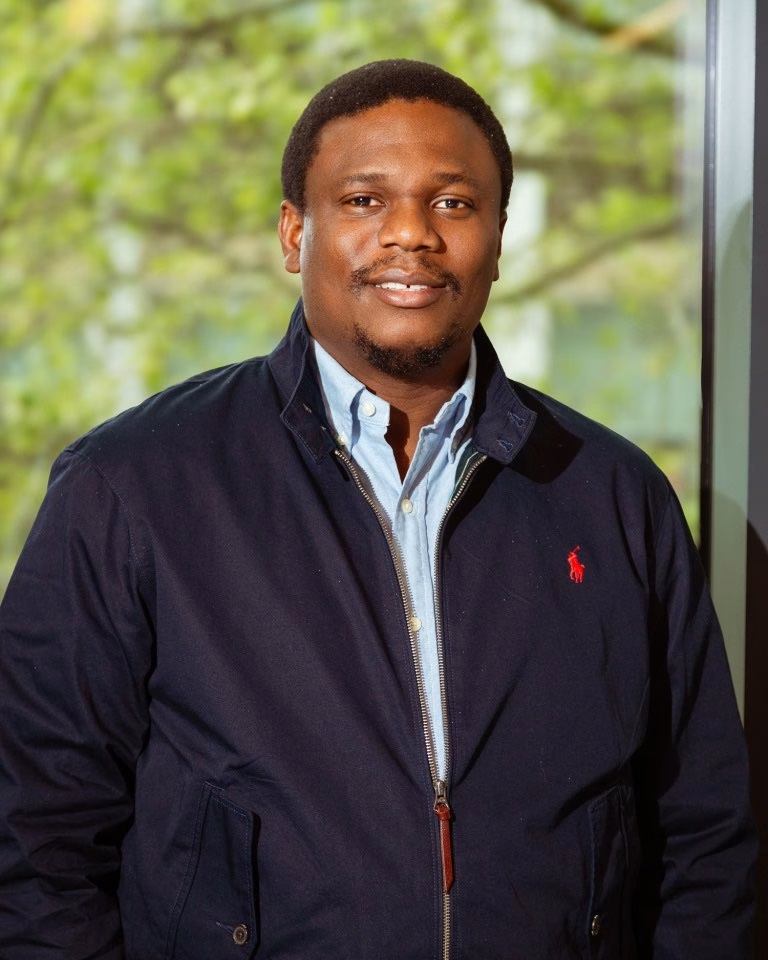
Comments by Tosin Eniolorunda, CEO of Moniepoint, have sparked a heated debate online after he questioned the quality of Nigeria’s talent pool while discussing his company’s hiring challenges.
Speaking at the The Platform Nigeria on May 1, Eniolorunda said the fintech firm had advertised over 500 vacancies since 2024 but struggled to find qualified local candidates. He revealed that by 2025, the company reversed its local-only hiring policy due to the shortage.
“I used to feel Nigerians are really bright… but we are still struggling to find Nigerians to fill those roles. They don’t meet global standards,” he said, attributing the gap to factors such as social media distractions, cybercrime, hookup culture, and weaknesses in the education system.
Backlash and Counterarguments
His remarks triggered swift backlash from Nigerians, particularly within the tech community, with many accusing local companies of failing to invest in talent development.
Critics argued that unlike global firms, Nigerian tech companies rarely offer structured, paid internship programs or training pipelines to groom young professionals. Some pointed to examples of international companies like Oracle Corporation, where internships and early talent programs serve as entry points into full-time roles.
Others shared personal experiences of being rejected by local firms despite strong resumes, while noting that Nigerian professionals continue to secure roles in global companies such as Amazon.
A recurring sentiment online was that many Nigerian companies demand “global-standard talent” but are unwilling to offer competitive compensation or career development opportunities.
Industry Perspective
Supporters of Eniolorunda’s stance, however, pointed to the realities of scaling a fast-growing fintech company in a competitive global market. They cited brain drain, limited specialized skills, and increasing demand for top-tier expertise as genuine challenges facing Nigerian startups.
Analysts say the controversy highlights a broader issue within Nigeria’s tech ecosystem balancing expectations between employers and job seekers, while addressing gaps in education, training, and remuneration.
The debate mirrors ongoing tensions around talent development, compensation, and hiring practices in Nigeria’s fast-evolving tech sector.
As companies expand and compete globally, the question of how to build, retain, and fairly reward talent is likely to remain a central issue.
i
Follow BONA NAIJA for more
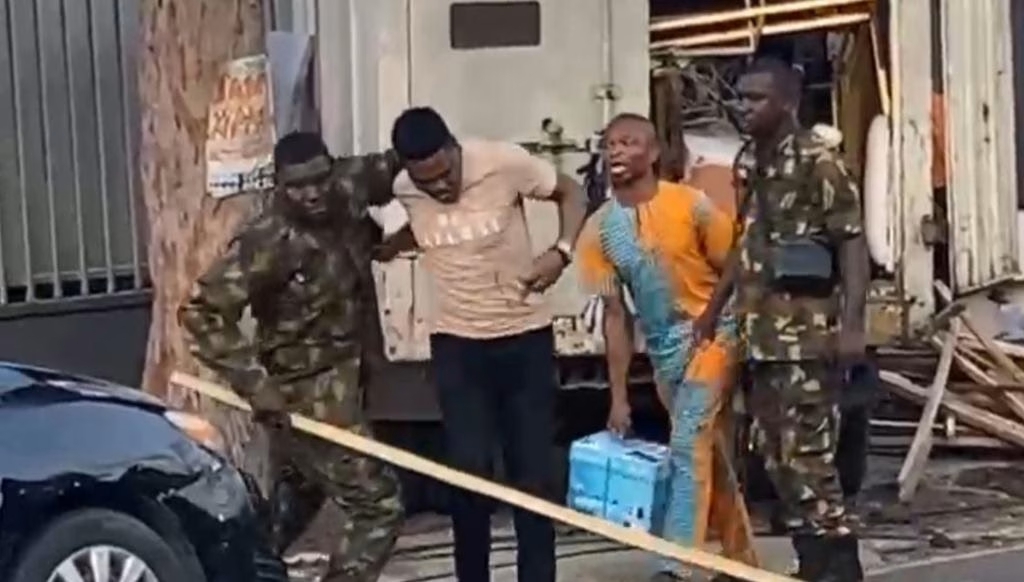
A Nigerian soldier has allegedly assaulted a journalist, Fakoyejo Olalekan, during a traffic control operation in Lagos State, triggering widespread public condemnation after video footage of the incident surfaced online.
The clash occurred on May 2 near Pleasant Event Centre in Ikeja, where personnel of the Nigerian Army were reportedly directing heavy traffic.
According to eyewitness accounts, the altercation began after Fakoyejo remarked to passengers that a soldier’s handling of a motorcyclist had caused an unnecessary delay. The comment allegedly angered one of the soldiers, who ordered everyone out of the vehicle.
The situation escalated when the soldier reportedly slapped and shoved the journalist, and briefly reached for a piece of wood before bystanders intervened to prevent further escalation.
Video clips circulating on social media show at least two soldiers involved in the confrontation. During the incident, Fakoyejo’s phone screen was also seen shattered on the pavement. No serious injuries were reported.
The footage has since triggered widespread criticism online, with many users calling for accountability and questioning the conduct of military personnel during civilian traffic enforcement duties.
As of May 4, the Nigerian Army had yet to issue an official response despite being tagged in multiple public complaints and posts about the incident.
Follow BONA NAIJA for more


The Department of State Services (DSS) on Monday arraigned Chidiebere Justice Mark, popularly known as Justice Crack, before the Federal High Court sitting in Abuja on a three-count charge bordering on cybercrime and alleged incitement against the military.
Mark was earlier arrested by the Nigerian Army over a viral video and accompanying statements he shared via his X (formerly Twitter) handle, @JusticeCrack, in which he reportedly alleged inadequate feeding of Nigerian soldiers.
According to the charge sheet, the defendant is accused of knowingly circulating false information intended to provoke public annoyance, ill will, and hatred among citizens.
Details of Charges
Count One alleges that on April 28, 2026, Mark disseminated information on social media regarding poor feeding conditions of Nigerian Army personnel, which authorities claim he knew to be false. The offence is said to contravene Section 24(1)(b) of the Cybercrimes (Prohibition, Prevention, etc.) Act, 2015 (as amended).
Count Two states that the accused published a viral video and statements about the Nigerian Army that triggered widespread negative reactions and were likely to cause fear and a breach of peace. This charge is brought under Section 59 of the Criminal Code Act.
Count Three accuses Mark of attempting to commit a felony by circulating what authorities described as derogatory content about the Army, also linked to potential public unrest, punishable under Section 509 of the Criminal Code Act.
Court Proceedings
Presiding judge, Joyce Abdulmalik, adjourned the case to May 25, 2026, for trial and possible hearing of a bail application. The court also ordered that the defendant be remanded in DSS custody pending further proceedings.
Public Reaction
The arraignment has sparked widespread reactions across social media, with civil rights advocates and concerned citizens debating issues around freedom of expression, national security, and the limits of online speech in Nigeria.
Follow BONA NAIJA for more
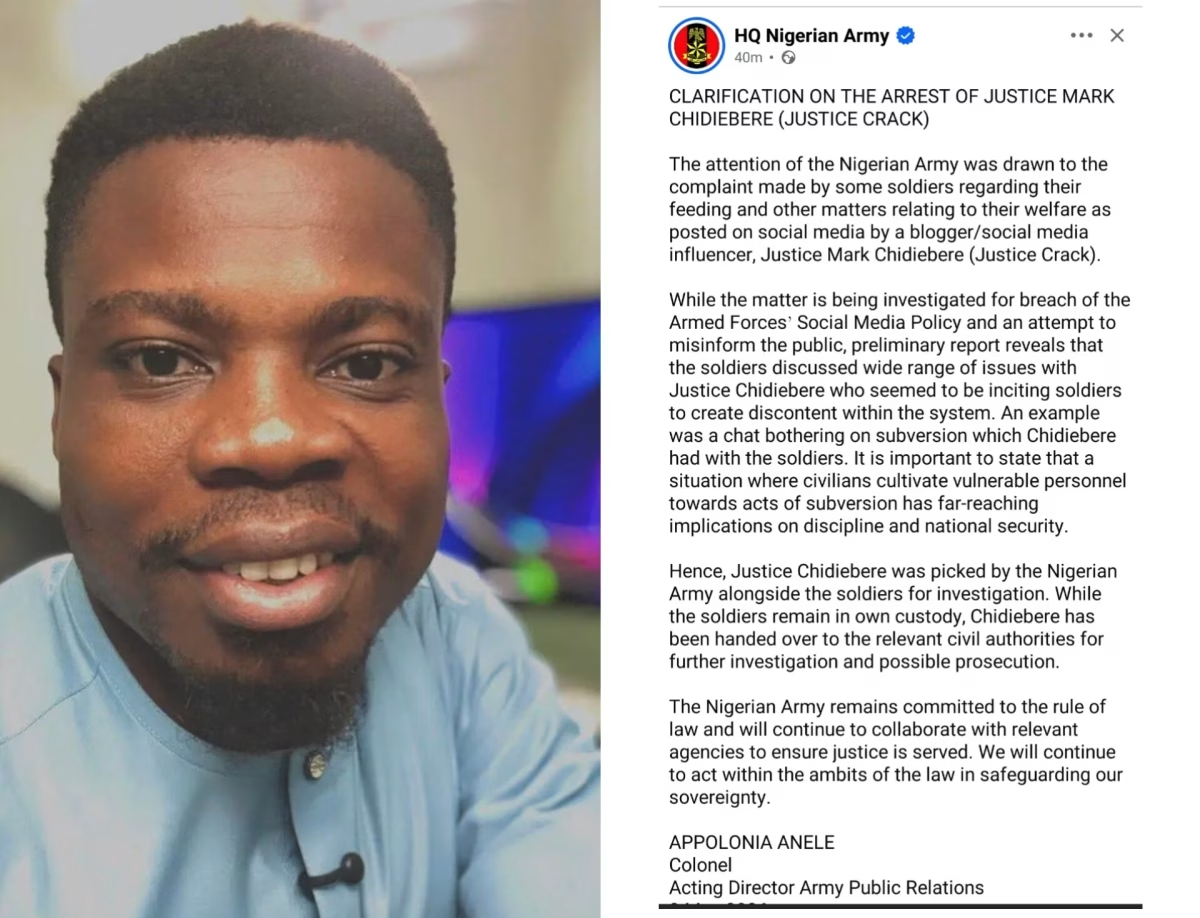
The Nigerian Army has clarified the circumstances surrounding the arrest of social media influencer Justice Mark Chidiebere, popularly known as “Justice Crack,” following complaints raised online.
In a statement issued on May 2, 2026, and signed by Appolonia Anele, Acting Director of Army Public Relations, the military said the arrest was linked to an ongoing investigation into alleged violations of the Armed Forces’ social media policy and attempts to misinform the public.
According to the Army, the development began after some soldiers reportedly raised concerns about feeding and welfare issues, which were later shared on social media by Chidiebere.
However, preliminary findings suggest that the influencer engaged the soldiers in conversations that went beyond welfare concerns, including discussions the Army described as bordering on subversion.
“Preliminary report reveals that the soldiers discussed a wide range of issues with Justice Chidiebere who seemed to be inciting soldiers to create discontent within the system,” the statement said.
The Army warned that any attempt by civilians to influence military personnel towards acts that could undermine discipline poses serious risks to national security.
“It is important to state that a situation where civilians cultivate vulnerable personnel towards acts of subversion has far-reaching implications on discipline and national security,” the statement added.
Following the development, Chidiebere was arrested alongside the soldiers involved. While the soldiers remain in military custody, he has been handed over to relevant civil authorities for further investigation and possible prosecution.
The Army reaffirmed its commitment to due process and the rule of law, stressing that all actions taken were within legal bounds.
“The Nigerian Army remains committed to the rule of law and will continue to collaborate with relevant agencies to ensure justice is served,” Anele stated.
The case has drawn public attention amid ongoing conversations about military welfare and freedom of expression on social media.
Follow BONA NAIJA for more

Shaibu Calls for Stronger Inter-Agency Collaboration as NIS Produces Nigeria’s First Certified Marathon Medical Director

Job Vancancy: Moniepoint Job Vacancies in Abuja and North Central Nigeria

Lookman Spotted in London Ahead of Arsenal vs Atletico UCL Showdown

2027 Bombshell: Ohanaeze Tells Peter Obi to Step Down for Tinubu

Burna Boy Splashes $100,000 on 6uff, Odumodublvck at Lagos Club Night

Nigerians Slam Moniepoint CEO Over ‘Talent Quality’ Remarks Amid Hiring Debate

Outrage as Soldier Assaults Journalist Over Traffic Dispute in Lagos

Outrage as DSS Arraigns Chidiebere Justice Mark Over Alleged Cybercrime, Military Incitement

Video: Fresh Blow to Obi–Kwankwaso Plan as Datti Questions Northern Backing ahead of 2027

PDP NEC Approves 13-Member Caretaker Committee Amid Internal Party Rift

News Flash: Court Suspends Secondus As PDP National Chairman, Member

2019 Presidency: Donald Duke’s Running Mate Quites Race Allegedly joins Atiku

Falana threaten to sue Kachikwu over $60bn oil revenue loss

#BONANAIJATV: Exclusive interview with OMPAN National President Comr Emeh James Anyalekwa #ompanowerri2018

Video : Phyno – Agu
Philippines president, Rodrigo Duterte brags about the size of his manhood

Video: Burna Boy – “Dangote”

VIDEO: Becca – Magic ft. Ycee

VIDEO: Patoranking x Davido – Confirm

TV personality Zainab Balogun reveals how she met her hubby and how his kids reaction when she told them she was going to be their new mum

Video: Screening of Former Governor of Kaduna State, Elrufai

OLISAE Rolls Out Video for New Song “SAMBELE” featuring Slowdog

Video: Dino Melaye mocks Tinubu during the PDP rally In Delta

Video: Shettima & I Will Not Abuse Each Other Like Obasanjo & Atiku – Bola Tinubu

Watch Sabinus’ Comedy on Tinubu, Peter Obi, other presidential candidates

Video: Buju feat. Burna Boy – Lenu (Remix)

VIDEO: Sammie Okposo – Nobody Can

VIDEO: Falz – Bop Daddy ft. Ms Banks

Watch Diane Russet’s Short Film “Bayi”

Video: Acoustic Performance of Patoranking’s “So Nice”


-

 Jobs3 weeks ago
ECOWAS Recruitment 2026: Massive Job Openings Across West Africa (Apply Now)
-
 Jobs3 weeks ago
Germany Embassy Abuja Announces Job Vacancy
-
 Jobs3 weeks ago
EU Invites Nigerian Graduates to Apply for 2026 Funded Traineeship in Abuja
-
 Jobs3 weeks ago
Research Interviewers Job: Jhpiego Hiring Across 36 States & FCT
-
 News3 weeks ago
Supreme Court Dismisses David Mark’s Application, Deepening ADC Leadership Crisis Ahead of 2027 Polls
-
 Music Video2 weeks ago
Fally Ipupa & Wizkid Ignite Charts with ‘JAM’ Video from XX Album
-
 News2 weeks ago
Captured Boko Haram Suspect Alleges Links to Senior Military Figure in Viral Interrogation Video
-
 Politics2 weeks ago
2027: Obi, Kwankwaso Supporters Launch ‘OK Movement’ Ahead of ADC Presidential Primary
-

 Events3 weeks ago
Emiralty Africa to Host ‘Emiralty Connect 1.0’ Summit in Lagos
-

 Politics3 weeks ago
ADC National Convention: Security Beefed Up as 3,000 Delegates Elect New NWC