
News
All you need to know as Buhari unveils CBN’s eNaira

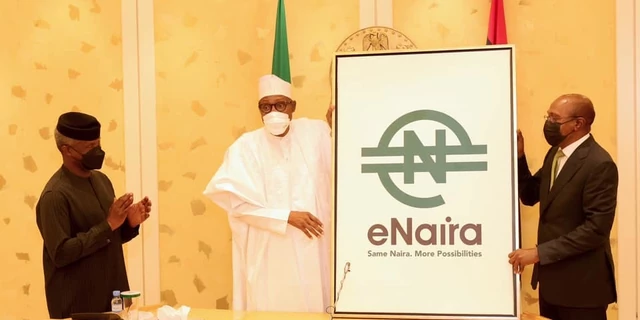
The President, Major General Muhammadu Buhari (retd), on Monday, unveiled the Central Bank of Nigeria’s digital currency, also known eNaira, in a keynote event attended by top government functionaries at the State House, Abuja.
He said Nigeria’s Central Bank Digital Currency and its underlying blockchain technology could increase the nation’s Gross Domestic Product by $29bn over the next 10 years.
In his address, the President said the e-currency would help increase remittances, foster cross-border trade, improve financial inclusion, make monetary policy more effective, and enable the government to send direct payments to citizens eligible for specific welfare programmes.
According to him, the digital currency will help move many more people and businesses from the informal into the formal sector, thereby increasing the country’s tax base.

Buhari said, “In recent times, the use of physical cash in conducting business and making payments has been on the decline. This trend has been exacerbated by the onset of the COVID-19 pandemic and the resurgence of a new digital economy.
“Alongside these developments, businesses, households, and other economic agents have sought for new means of making payments in the new circumstances.”
Buhari lauded the CBN for coming up with the eNaira.
Central bank mints 500m eNaira, issues 200m to banks
On his part, the Governor, CBN, Godwin Emefiele, said since the eNaira platform went live, there had been overwhelming interest and encouraging response from Nigerians and other parties across the world with over 2.5 million daily visits to the website.
He said, “Thirty-three banks are fully integrated and live on the platform, N500m has been successfully minted by the bank, N200m has been issued to financial institutions, over 2,000 customers have been onboarded and over 120 merchants have successfully registered on the eNaira platform.”
The CBN governor also used the occasion to commend the President for “making history, yet again,” with the launch of the eNaira – the first in Africa and one of the earliest around the world.
Emefiele announced a new financial instrument titled, “The 100 for 100 PPP – Policy on Production and Productivity”, which he said would be domiciled in the Development Finance Department of the CBN under his direct supervision.
He explained that under this policy, the CBN would advertise, screen, scrutinise and financially support 100 targeted private sector companies in 100 days, beginning from November 1, 2021.
The event was attended by Vice-President Yemi Osinbajo; the Secretary to the Government of the Federation, Boss Mustapha; the Chief of Staff to the President, Prof. Ibrahim Gambari; members of the Federal Executive Council; top officials of the CBN and heads of relevant government agencies.
Transactions on eNaira platform free for 90 days – CBN
Meanwhile, the CBN disclosed that all transactions conducted on the newly-launched digital currency platform would be free for 90 days.
The regulator, however, stated that it would revert to its guide on applicable charges by banks and other financial and non-financial institutions at the end of the stated period.
The apex bank also said that Ministries, Departments and Agencies could make payments and collect revenues using the eNaira wallet.
The CBN disclosed this in the framework titled, ‘eNaira Circular and Guidelines’, which was later released on Monday.
The central bank guide read in part, “The charges for transactions that originate from the eNaira platform shall be free for the first 90 days commencing from October 25, 2021 and then revert to applicable charges as outlined in the Guide to Charges by Banks, Other Financial and Non-bank Financial Institutions. MDAs may collect revenues or make payments in eNaira.”
eNaira won’t change naira-dollar exchange rate – Experts
Meanwhile, economic and financial experts have said that the eNaira will not change or affect the value of the naira in the foreign exchange market.
They also expressed concern over the risk of cyber attacks on the eNaira accounts of Nigerians.
They spoke against the backdrop of the unveiling of the eNaira by the CBN.
The immediate past Director-General of the Lagos Chamber of Commerce and Industry, Dr. Muda Yusuf, said there was no relationship between foreign exchange market and the eNaira.
He said, “There is no connection between the eNaira and the exchange rate. No relationship at all. Exchange rate is determined by the demand and supply fundamentals in the foreign exchange market.
“These are driven largely by imports, exports and the flow of capital across borders. The naira, whether digital or physical, is just a means of exchange and to some extent, a store of value.”
He, however, noted that the eNaira was consistent with current digitalisation trend across all sectors globally.
Yusuf, who is the chief executive officer, Centre for the Promotion of Private Enterprises, explained that digital applications typically came with efficiency, cost effectiveness, smartness in usage and convenience.
“But it is still not clear what the value proposition of the eNaira is, beyond the psychological satisfaction of joining the league of countries with digital currencies,” Yusuf stated.
The CPPE boss noted that transactions on these platforms were already in trillions of naira, and still counting, adding that it remained to be seen what additional value the eNaira would bring.
He said, “A great deal of sensitisation and awareness need to be undertaken to generate trust and confidence in this new payment system initiative.
“International investors typically would prefer a currency that is acceptable globally and convertible such as the dollar.”
He observed that many Nigerians were still trying to understand what the eNaira really entailed. A financial analyst and Senior Lecturer at the Pan Atlantic University and a financial analyst, Dr Olalekan Aworinde, said there was a need to do more sensitise the public more on the risks.
He said, “I think that the CBN should be aware of the fact that there is the risk of cyber attacks with the introduction of the eNaira.
“As a result, the CBN needs to properly educate the masses on how to use the eNaira in a way that would not put their safety and the safety of their funds at risk.
Another expert and the Chief Executive Officer of SD&D Capital Management Limited, Mr Idakolo Gbolade, also said there was the need to sensitive the public the more.
How to use the eNaira:
What Is ENaira?
The eNaira will be a digital representative of the paper Naira currency issued by the Central Bank of Nigeria. It will also be a complementary legal tender in Nigeria, having the same exchange value as the Naira and maintaining a parity of value as the Naira. One interesting feature of the eNaira is that it will not earn any interest to the holder, and it is built on a blockchain open ledger technology. This simply implies that you cannot have a duplicate of eNaira or a fake version of it because each note will be unique.
How Safe Is The ENaira?
If it involves money, then safety is of paramount importance. The eNaira is designed to solve any verification risk by assuring all holders that each eNaira is a valid token. This authenticity is achieved by building the eNaira block chain that makes it difficult or impossible to change, hack, or cheat the system. Thus, every retailer is likely to accept the eNaira because it cannot be forged or duplicated.
How Do I Access The ENaira?
The CBN has planned a rollout in a tiered manner. First, it will issue the eNaira to financial institutions like banks. Your bank will then retail the eNaira to you. If your transaction value is less than N50,000 a day, you don’t need a bank account to get the eNaira; you can use a NIN verified phone number to buy eNaira. If you want to withdraw more than N50,000 but up to the daily limit of N1 million, you will need a BVN in addition to a verified phone number.
The CBN has very strict “Know Your Customers” protocols for this process. The aim is to assure all retailers of the safety and utility of the eNaira.
Why Should I Use ENaira?
The eNaira has a low-cost advantage. The daily transfers between accounts are at no cost to the holder of the account and lower transaction cost is a massive incentive, as traders will pay no fees for withdrawals and deposits to any bank account. Thus, there will be no transaction fees but improved financial safety.
How Will Dollar Remittance To ENaira Work?
The eNaira will be integrated into the CBN’s forex process, and this is to make it easier to receive remittances to Nigeria. These transfers could be from the CBN crediting eNaira directly to the international Money Transfer Organisation (IMTO). So a Nigerian abroad sending $100 to his uncle can debit his US bank account and credit $100 to an IMTO, who will buy eNaira from the corresponding bank in Nigeria. Then the $100 is converted to eNaira instantly, at a far lower transfer fee. This is a real benefit and a significant advantage the eNaira will provide to customers.
The Potential Of The ENaira
Any two parties who can credit a Nigerian banking institution with corresponding currency can use the eNaira. This means a trader banking with UBA in Burkina Faso can settle his import bills from the Gambia using eNaira. This will be the next level of the rollout for financial institutions to build out an ecosystem with eNaira as the base product.
Furthermore, the CBN outlines that eNaira will bring the vast majority of Nigerians who have no bank account but have a phone into the formal financial economy. The eNaira can also be used for salary payments and payments for goods and services. So an electrician can accept payment on his phone, store them in his wallet, and make transactions with any vendor.
What Are The Risks?
The eNaira is online, the BVN and NIN information is also online, so the risk of malicious actors attempting to hack or gain access to the data is very low. Even more, CBN has assured a more secured process with eNaira tokens. Overall, it appears to be a positive progression towards a cashless society, with lower costs and higher productivity for Nigerians.







Leading Nigerian fintech company Moniepoint has announced six new job openings across Abuja and several states in the North Central region, expanding its workforce in compliance, technical operations, sales, and security management.
The vacancies cut across multiple departments, reflecting the company’s continued growth in agent banking, SME solutions, and digital financial infrastructure services.
Available Positions
Field Risk & Internal Control Officer (North Central)
- Team: Compliance
- Location: FCT, Nigeria
The role focuses on monitoring operational risks, enforcing internal control standards, and ensuring compliance across field operations in the region.
Apply Here
Hardware Engineer
- Team: Advanced Technical Operations
- Location: FCT, Nigeria
Successful candidates will handle hardware installation, maintenance, troubleshooting, and technical support for field operations.
Apply Here
Implementation Officer (North Central)
- Team: Moniebook Business Management Tools
- Locations: Benue, Plateau, FCT
This role involves onboarding merchants and ensuring smooth deployment of Moniepoint’s business tools across assigned regions.
Apply Here
Inbound Sales Officer (Abuja)
- Team: Moniebook Business Management Tools
- Location: FCT, Nigeria
The position focuses on handling inbound customer inquiries, converting leads, and supporting sales growth for Moniepoint business solutions.
Apply Here
Regional Lead, Corporate Security (North)
- Team: Moniepoint MFB
- Locations: FCT, Kano
The role oversees corporate security operations, risk prevention strategies, and protection of company assets across northern Nigeria.
Apply Here
Regional Lead, Field Risk & Internal Control (North)
- Team: Compliance
- Location: FCT, Nigeria
This leadership position is responsible for coordinating regional risk management teams and strengthening internal control systems.
Apply Here
The hiring drive comes as fintech companies in Nigeria continue to expand their physical and digital operations across underserved regions, particularly in agent banking and SME support services.
Moniepoint, one of the fastest-growing fintech firms in the country, has steadily increased recruitment in technical, compliance, and field operations roles over the past year.
With these openings, Moniepoint is strengthening its presence in Abuja and northern Nigeria while scaling its financial services infrastructure across the country.
Follow BONA NAIJA for more

Comments by Tosin Eniolorunda, CEO of Moniepoint, have sparked a heated debate online after he questioned the quality of Nigeria’s talent pool while discussing his company’s hiring challenges.
Speaking at the The Platform Nigeria on May 1, Eniolorunda said the fintech firm had advertised over 500 vacancies since 2024 but struggled to find qualified local candidates. He revealed that by 2025, the company reversed its local-only hiring policy due to the shortage.
“I used to feel Nigerians are really bright… but we are still struggling to find Nigerians to fill those roles. They don’t meet global standards,” he said, attributing the gap to factors such as social media distractions, cybercrime, hookup culture, and weaknesses in the education system.
Backlash and Counterarguments
His remarks triggered swift backlash from Nigerians, particularly within the tech community, with many accusing local companies of failing to invest in talent development.
Critics argued that unlike global firms, Nigerian tech companies rarely offer structured, paid internship programs or training pipelines to groom young professionals. Some pointed to examples of international companies like Oracle Corporation, where internships and early talent programs serve as entry points into full-time roles.
Others shared personal experiences of being rejected by local firms despite strong resumes, while noting that Nigerian professionals continue to secure roles in global companies such as Amazon.
A recurring sentiment online was that many Nigerian companies demand “global-standard talent” but are unwilling to offer competitive compensation or career development opportunities.
Industry Perspective
Supporters of Eniolorunda’s stance, however, pointed to the realities of scaling a fast-growing fintech company in a competitive global market. They cited brain drain, limited specialized skills, and increasing demand for top-tier expertise as genuine challenges facing Nigerian startups.
Analysts say the controversy highlights a broader issue within Nigeria’s tech ecosystem balancing expectations between employers and job seekers, while addressing gaps in education, training, and remuneration.
The debate mirrors ongoing tensions around talent development, compensation, and hiring practices in Nigeria’s fast-evolving tech sector.
As companies expand and compete globally, the question of how to build, retain, and fairly reward talent is likely to remain a central issue.
i
Follow BONA NAIJA for more

A Nigerian soldier has allegedly assaulted a journalist, Fakoyejo Olalekan, during a traffic control operation in Lagos State, triggering widespread public condemnation after video footage of the incident surfaced online.
The clash occurred on May 2 near Pleasant Event Centre in Ikeja, where personnel of the Nigerian Army were reportedly directing heavy traffic.
According to eyewitness accounts, the altercation began after Fakoyejo remarked to passengers that a soldier’s handling of a motorcyclist had caused an unnecessary delay. The comment allegedly angered one of the soldiers, who ordered everyone out of the vehicle.
The situation escalated when the soldier reportedly slapped and shoved the journalist, and briefly reached for a piece of wood before bystanders intervened to prevent further escalation.
Video clips circulating on social media show at least two soldiers involved in the confrontation. During the incident, Fakoyejo’s phone screen was also seen shattered on the pavement. No serious injuries were reported.
The footage has since triggered widespread criticism online, with many users calling for accountability and questioning the conduct of military personnel during civilian traffic enforcement duties.
As of May 4, the Nigerian Army had yet to issue an official response despite being tagged in multiple public complaints and posts about the incident.
Follow BONA NAIJA for more


The Department of State Services (DSS) on Monday arraigned Chidiebere Justice Mark, popularly known as Justice Crack, before the Federal High Court sitting in Abuja on a three-count charge bordering on cybercrime and alleged incitement against the military.
Mark was earlier arrested by the Nigerian Army over a viral video and accompanying statements he shared via his X (formerly Twitter) handle, @JusticeCrack, in which he reportedly alleged inadequate feeding of Nigerian soldiers.
According to the charge sheet, the defendant is accused of knowingly circulating false information intended to provoke public annoyance, ill will, and hatred among citizens.
Details of Charges
Count One alleges that on April 28, 2026, Mark disseminated information on social media regarding poor feeding conditions of Nigerian Army personnel, which authorities claim he knew to be false. The offence is said to contravene Section 24(1)(b) of the Cybercrimes (Prohibition, Prevention, etc.) Act, 2015 (as amended).
Count Two states that the accused published a viral video and statements about the Nigerian Army that triggered widespread negative reactions and were likely to cause fear and a breach of peace. This charge is brought under Section 59 of the Criminal Code Act.
Count Three accuses Mark of attempting to commit a felony by circulating what authorities described as derogatory content about the Army, also linked to potential public unrest, punishable under Section 509 of the Criminal Code Act.
Court Proceedings
Presiding judge, Joyce Abdulmalik, adjourned the case to May 25, 2026, for trial and possible hearing of a bail application. The court also ordered that the defendant be remanded in DSS custody pending further proceedings.
Public Reaction
The arraignment has sparked widespread reactions across social media, with civil rights advocates and concerned citizens debating issues around freedom of expression, national security, and the limits of online speech in Nigeria.
Follow BONA NAIJA for more

The Nigerian Army has clarified the circumstances surrounding the arrest of social media influencer Justice Mark Chidiebere, popularly known as “Justice Crack,” following complaints raised online.
In a statement issued on May 2, 2026, and signed by Appolonia Anele, Acting Director of Army Public Relations, the military said the arrest was linked to an ongoing investigation into alleged violations of the Armed Forces’ social media policy and attempts to misinform the public.
According to the Army, the development began after some soldiers reportedly raised concerns about feeding and welfare issues, which were later shared on social media by Chidiebere.
However, preliminary findings suggest that the influencer engaged the soldiers in conversations that went beyond welfare concerns, including discussions the Army described as bordering on subversion.
“Preliminary report reveals that the soldiers discussed a wide range of issues with Justice Chidiebere who seemed to be inciting soldiers to create discontent within the system,” the statement said.
The Army warned that any attempt by civilians to influence military personnel towards acts that could undermine discipline poses serious risks to national security.
“It is important to state that a situation where civilians cultivate vulnerable personnel towards acts of subversion has far-reaching implications on discipline and national security,” the statement added.
Following the development, Chidiebere was arrested alongside the soldiers involved. While the soldiers remain in military custody, he has been handed over to relevant civil authorities for further investigation and possible prosecution.
The Army reaffirmed its commitment to due process and the rule of law, stressing that all actions taken were within legal bounds.
“The Nigerian Army remains committed to the rule of law and will continue to collaborate with relevant agencies to ensure justice is served,” Anele stated.
The case has drawn public attention amid ongoing conversations about military welfare and freedom of expression on social media.
Follow BONA NAIJA for more

Shaibu Calls for Stronger Inter-Agency Collaboration as NIS Produces Nigeria’s First Certified Marathon Medical Director

Job Vancancy: Moniepoint Job Vacancies in Abuja and North Central Nigeria

Lookman Spotted in London Ahead of Arsenal vs Atletico UCL Showdown

2027 Bombshell: Ohanaeze Tells Peter Obi to Step Down for Tinubu

Burna Boy Splashes $100,000 on 6uff, Odumodublvck at Lagos Club Night

Nigerians Slam Moniepoint CEO Over ‘Talent Quality’ Remarks Amid Hiring Debate

Outrage as Soldier Assaults Journalist Over Traffic Dispute in Lagos

Outrage as DSS Arraigns Chidiebere Justice Mark Over Alleged Cybercrime, Military Incitement

Video: Fresh Blow to Obi–Kwankwaso Plan as Datti Questions Northern Backing ahead of 2027

PDP NEC Approves 13-Member Caretaker Committee Amid Internal Party Rift

News Flash: Court Suspends Secondus As PDP National Chairman, Member

2019 Presidency: Donald Duke’s Running Mate Quites Race Allegedly joins Atiku

Falana threaten to sue Kachikwu over $60bn oil revenue loss

#BONANAIJATV: Exclusive interview with OMPAN National President Comr Emeh James Anyalekwa #ompanowerri2018

Video : Phyno – Agu
Philippines president, Rodrigo Duterte brags about the size of his manhood

Video: Burna Boy – “Dangote”

VIDEO: Becca – Magic ft. Ycee

VIDEO: Patoranking x Davido – Confirm

TV personality Zainab Balogun reveals how she met her hubby and how his kids reaction when she told them she was going to be their new mum

Video: Screening of Former Governor of Kaduna State, Elrufai

OLISAE Rolls Out Video for New Song “SAMBELE” featuring Slowdog

Video: Dino Melaye mocks Tinubu during the PDP rally In Delta

Video: Shettima & I Will Not Abuse Each Other Like Obasanjo & Atiku – Bola Tinubu

Watch Sabinus’ Comedy on Tinubu, Peter Obi, other presidential candidates

Video: Buju feat. Burna Boy – Lenu (Remix)

VIDEO: Sammie Okposo – Nobody Can

VIDEO: Falz – Bop Daddy ft. Ms Banks

Watch Diane Russet’s Short Film “Bayi”

Video: Acoustic Performance of Patoranking’s “So Nice”


-

 Jobs3 weeks ago
ECOWAS Recruitment 2026: Massive Job Openings Across West Africa (Apply Now)
-
 Jobs3 weeks ago
Germany Embassy Abuja Announces Job Vacancy
-

 Jobs3 weeks ago
EU Invites Nigerian Graduates to Apply for 2026 Funded Traineeship in Abuja
-
 Jobs3 weeks ago
Research Interviewers Job: Jhpiego Hiring Across 36 States & FCT
-
 News3 weeks ago
Supreme Court Dismisses David Mark’s Application, Deepening ADC Leadership Crisis Ahead of 2027 Polls
-
 Music Video2 weeks ago
Fally Ipupa & Wizkid Ignite Charts with ‘JAM’ Video from XX Album
-
 Politics2 weeks ago
2027: Obi, Kwankwaso Supporters Launch ‘OK Movement’ Ahead of ADC Presidential Primary
-
 News2 weeks ago
Captured Boko Haram Suspect Alleges Links to Senior Military Figure in Viral Interrogation Video
-

 Events3 weeks ago
Emiralty Africa to Host ‘Emiralty Connect 1.0’ Summit in Lagos
-

 Politics3 weeks ago
ADC National Convention: Security Beefed Up as 3,000 Delegates Elect New NWC