
News
Nigeria Did Not Endorse The OECD Minimum Corporate Tax Agreement In The Country’s Best Interest – FIRS



Nigeria’s cautious approach to the endorsement of the Organization for Economic Cooperation and Development (OECD)/ G20 Inclusive Framework two-pillar solution to the taxation of the digital economy is in the best interest of the country, and to ensure that Nigeria does not lose out on potential revenue from the digital economy.
This was explained in a statement issued to the press by the Executive Chairman of the Federal Inland Revenue Service (FIRS), Muhammad Nami, on Monday.
Explaining in his statement, why the agreement is unfair to Nigeria and the developing countries in general, Muhammad Nami stated that the country, having reviewed the conditions of the agreement had concerns over the impact that the signing of the agreement would have on the country’s tax system and tax revenue generation.
“There are serious concerns on how the rules would compound the issues in our tax system. For instance, to be able to tax any digital sale or any multinational enterprise (MNEs), that company or enterprise must have an annual global turnover of €20 billion and a global profitability of 10%. That is a concern. This is because most MNEs that operate in our country do not meet such criteria and we would not be able to tax them.
“Secondly, the €20 billion global annual turnover in question is not just for one accounting year, but it is that the enterprise must make €20 billion revenue and 10% profitability in average for four consecutive years, otherwise that enterprise will never pay tax in our country, but in the country where the enterprise comes from, or its country of residence,” the statement read.
Thirdly he noted that for Nigeria to subject a Multinational Enterprise to tax under the rule, the entity must have generated at least €1 million turnover from Nigeria within a year.
Mr. Muhammad Nami stated that this is an unfair position especially to domestic companies which, with a minimum of above N25 million (that is about €57,000) turnover, are subject to companies income tax in Nigeria. He added that this rule will take-off so many Multinational Enterprises from the scope of those that are currently paying taxes to Nigeria. In other words, even the MNEs that are currently paying taxes in Nigeria would cease to pay taxes to us because of this rule.
Fourthly, on the issue of dispute resolutions under the Two-Pillar Solution, the FIRS Executive Chairman explained that the rules were such that in the event of a dispute between Nigeria and a Multinational Enterprise, Nigeria would be subject to an international arbitration panel as against Nigeria’s own justice system.
“It would be subject to international arbitration and not Nigeria’s judicial system and laws—even where the income is directly related to a Nigerian member of an MNE group, which is ordinarily subject to tax in Nigeria on its worldwide income and subject to the laws of Nigeria. We are concerned about getting a fair deal from such process. More so, such a dispute resolution process with a Multinational Enterprise, in an international arbitration panel outside the country, would lead to heavy expenses on legal services, traveling and other incidental costs.
“Nigeria would spend more; even beyond the tax yield from such cases,” the statement read.
On the issue of Nigeria loosing significant revenue if it fails to sign into the OECD Inclusive Framework rules for the taxation of the digital economy, the FIRS Executive Chairman noted that this was not a problem as the country had already put forward four ongoing solutions to the challenge of taxation of the digital economy.
“One, we have made it a point of practice to annually amend our tax laws to reflect the current global realities, it was courtesy of these reviews that we developed the Significant Economic Presence (SEP) rule, through the Finance Act of 2019 and 2020. The SEP rules set threshold for Multinational Enterprises, without physical presence in Nigeria, for registration and payment of taxes to the country.
“Two, we have deployed technology in order for us to bring digital transactions to the tax net. Coupled with the Significant Economic Presence rule, we have started seeing the impact of the technology we have deployed; companies like Twitter, Facebook, Netflix, LinkedIn, among others who have no physical presence in Nigeria and that were hitherto not paying taxes have now registered for tax purposes and are paying taxes accordingly. A positive to this is that we surpassed our target in the year 2021, despite the challenge posed to the global economy, including our own economy, by the Covid-19 pandemic.
“The third initiative is the Data-4-Tax Initiative, a blockchain technology which FIRS is jointly developing with the Internal Revenue Service of the 36 states and that of the FCT, under the auspices of the Joint Tax Board. With this project we are confident that we are going to have a seamless view and access to all economic activities of individuals and corporate bodies in Nigeria going forward, including money spent on digital commerce.
“The fourth is that we have set up a specialised office, the Non-Resident Persons Tax Office, to manage the taxation of non-resident persons and cross-border transactions, including all tax treaty operational issues and income derived from Nigeria by non-resident individuals and companies,” the statement read.
The Executive Chairman, FIRS appreciated members of the Nigerian public who had raised concerns at various occasions over Nigeria’s decision not to endorse the Two-Pillar solution, stating that their concerns came from a place of genuine passion and patriotism, anchored on seeking a better Nigeria.
“The concerns over Nigeria’s decision not to endorse the agreement are well-understood by us. We know that these questions come from a place of genuine concern and passion for a better Nigeria. We appreciate your patriotism,” Mr Nami said.



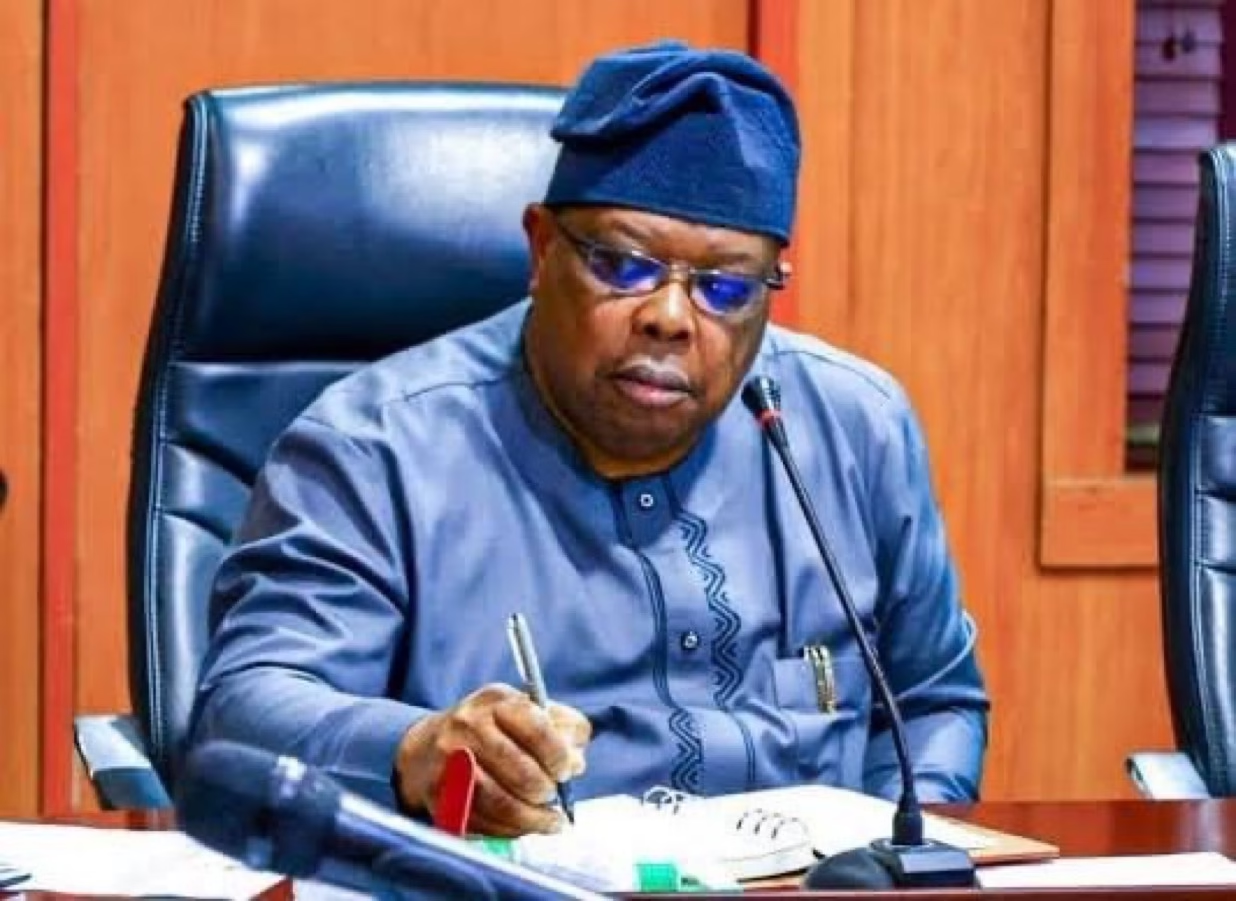
The Senate of Nigeria has confirmed Joseph Tegbe as Nigeria’s new Minister of Power following his screening before lawmakers on Wednesday.
Tegbe’s confirmation comes at a critical time for Nigeria’s electricity sector, which continues to battle persistent grid collapses, inadequate power supply, transmission challenges, gas shortages, and mounting industry debts.
During the screening, Tegbe unveiled an ambitious reform agenda aimed at stabilising the national grid within his first 100 days in office. He also pledged to introduce a transparency dashboard to improve accountability across the sector and proposed tariff reforms designed to protect vulnerable households while ensuring sustainability in the power industry.
The new minister, a civil engineering graduate with decades of experience in consulting, regulatory reforms, and corporate governance, previously worked with KPMG and has been involved in several public sector transformation initiatives.
Tegbe replaces Adebayo Adelabu amid growing public concern over Nigeria’s electricity crisis. Despite an installed generation capacity estimated at over 13,000 megawatts, the country reportedly distributes less than 4,500 megawatts due to transmission bottlenecks and operational inefficiencies.
Lawmakers who participated in the screening urged the incoming minister to focus on long-term structural reforms rather than temporary fixes. Several senators commended Tegbe’s composure and depth of knowledge during the session but stressed that Nigerians would ultimately judge his performance by results.
Observers say his appointment will test the government’s commitment to resolving one of the country’s most pressing infrastructure challenges, as millions of Nigerians continue to grapple with unreliable electricity supply and rising energy costs.
Follow BONA NAIJA for more

The Federal Government has officially banned recipients of honorary degrees from using the “Dr” title as a prefix to their names, in a move aimed at curbing the misuse and politicisation of academic honours.
The directive was announced on Wednesday by the Minister of Education, Tunji Alausa, following a Federal Executive Council (FEC) meeting held at the Presidential Villa in Abuja.
Speaking to State House correspondents, Alausa expressed concern over what he described as the growing abuse of honorary doctorate awards across the country.
“The recent trend we’ve seen with the award of honorary degrees has revealed a growing abuse and politicisation of this academic privilege,” he said.
“We’ve seen awards being used for political patronage, for financial gain, as well as the conferral of awards on serving public officials, which, as part of the ethics of honorary degree awards, should not happen.”
New Directive Takes Effect
Under the new policy, individuals conferred with honorary doctorate degrees will no longer be allowed to use “Dr” as a prefix in any official, academic, or professional setting.
Instead, recipients are required to clearly state the full honorary designation after their names—for example, John Doe, Honorary Doctor of Letters (D.Litt)—rather than adopting the “Dr” title.
The government clarified that only individuals who have earned doctoral degrees through academic study or are certified medical practitioners will retain the legal and professional right to use the “Dr” prefix.
Move to Restore Academic Integrity
The decision is part of broader efforts by the Federal Government to restore credibility and integrity to Nigeria’s education system, particularly in the awarding of honorary degrees.
Education stakeholders have long raised concerns over the proliferation of honorary doctorate awards, with some institutions accused of granting such honours without strict academic or ethical standards.
Observers say the new regulation is expected to discourage the commercialisation of honorary degrees and reinforce the distinction between earned academic qualifications and ceremonial recognitions.
Follow BONA NAIJA for more

A luxury Mercedes-Benz G-Class G63 AMG was involved in a late-night crash on a major highway in Abuja, killing six cows and sparking renewed concerns over road safety and enforcement of grazing laws in the Federal Capital Territory.
The incident occurred around 8 p.m. on Monday,
according to eyewitness accounts, when the high-speed SUV collided with a herd of cows that had reportedly strayed onto the roadway. A video circulating on social media shows the aftermath, with the white cows lying across the dark highway as traffic officials worked to manage the situation.
As of the time of filing this report, there were no confirmed injuries to the driver or any passengers in the vehicle. Unverified reports on social media suggested that the SUV sustained only minor damage despite the severity of the collision.
The accident has reignited debates over the continued presence of cattle on major roads in Abuja, despite the 2017 ban on open grazing introduced by the Federal Capital Territory Administration. The policy was designed to curb frequent clashes between herders and communities, as well as prevent traffic disruptions and accidents caused by roaming livestock.
Residents and road users have repeatedly raised concerns about the enforcement of the grazing ban, noting that cows are still often seen along highways and within urban areas of the capital. Monday night’s crash is the latest in a series of such incidents, highlighting ongoing gaps in regulation and compliance.
Authorities are yet to release an official statement on the crash or confirm whether any action will be taken regarding the presence of the cattle on the highway.
WATCH VIDEO
Follow BONA NAIJA for more

Leading Nigerian fintech company Moniepoint has announced six new job openings across Abuja and several states in the North Central region, expanding its workforce in compliance, technical operations, sales, and security management.
The vacancies cut across multiple departments, reflecting the company’s continued growth in agent banking, SME solutions, and digital financial infrastructure services.
Available Positions
Field Risk & Internal Control Officer (North Central)
- Team: Compliance
- Location: FCT, Nigeria
The role focuses on monitoring operational risks, enforcing internal control standards, and ensuring compliance across field operations in the region.
Apply Here
Hardware Engineer
- Team: Advanced Technical Operations
- Location: FCT, Nigeria
Successful candidates will handle hardware installation, maintenance, troubleshooting, and technical support for field operations.
Apply Here
Implementation Officer (North Central)
- Team: Moniebook Business Management Tools
- Locations: Benue, Plateau, FCT
This role involves onboarding merchants and ensuring smooth deployment of Moniepoint’s business tools across assigned regions.
Apply Here
Inbound Sales Officer (Abuja)
- Team: Moniebook Business Management Tools
- Location: FCT, Nigeria
The position focuses on handling inbound customer inquiries, converting leads, and supporting sales growth for Moniepoint business solutions.
Apply Here
Regional Lead, Corporate Security (North)
- Team: Moniepoint MFB
- Locations: FCT, Kano
The role oversees corporate security operations, risk prevention strategies, and protection of company assets across northern Nigeria.
Apply Here
Regional Lead, Field Risk & Internal Control (North)
- Team: Compliance
- Location: FCT, Nigeria
This leadership position is responsible for coordinating regional risk management teams and strengthening internal control systems.
Apply Here
The hiring drive comes as fintech companies in Nigeria continue to expand their physical and digital operations across underserved regions, particularly in agent banking and SME support services.
Moniepoint, one of the fastest-growing fintech firms in the country, has steadily increased recruitment in technical, compliance, and field operations roles over the past year.
With these openings, Moniepoint is strengthening its presence in Abuja and northern Nigeria while scaling its financial services infrastructure across the country.
Follow BONA NAIJA for more

Comments by Tosin Eniolorunda, CEO of Moniepoint, have sparked a heated debate online after he questioned the quality of Nigeria’s talent pool while discussing his company’s hiring challenges.
Speaking at the The Platform Nigeria on May 1, Eniolorunda said the fintech firm had advertised over 500 vacancies since 2024 but struggled to find qualified local candidates. He revealed that by 2025, the company reversed its local-only hiring policy due to the shortage.
“I used to feel Nigerians are really bright… but we are still struggling to find Nigerians to fill those roles. They don’t meet global standards,” he said, attributing the gap to factors such as social media distractions, cybercrime, hookup culture, and weaknesses in the education system.
Backlash and Counterarguments
His remarks triggered swift backlash from Nigerians, particularly within the tech community, with many accusing local companies of failing to invest in talent development.
Critics argued that unlike global firms, Nigerian tech companies rarely offer structured, paid internship programs or training pipelines to groom young professionals. Some pointed to examples of international companies like Oracle Corporation, where internships and early talent programs serve as entry points into full-time roles.
Others shared personal experiences of being rejected by local firms despite strong resumes, while noting that Nigerian professionals continue to secure roles in global companies such as Amazon.
A recurring sentiment online was that many Nigerian companies demand “global-standard talent” but are unwilling to offer competitive compensation or career development opportunities.
Industry Perspective
Supporters of Eniolorunda’s stance, however, pointed to the realities of scaling a fast-growing fintech company in a competitive global market. They cited brain drain, limited specialized skills, and increasing demand for top-tier expertise as genuine challenges facing Nigerian startups.
Analysts say the controversy highlights a broader issue within Nigeria’s tech ecosystem balancing expectations between employers and job seekers, while addressing gaps in education, training, and remuneration.
The debate mirrors ongoing tensions around talent development, compensation, and hiring practices in Nigeria’s fast-evolving tech sector.
As companies expand and compete globally, the question of how to build, retain, and fairly reward talent is likely to remain a central issue.
i
Follow BONA NAIJA for more
-

 Jobs4 weeks ago
ECOWAS Recruitment 2026: Massive Job Openings Across West Africa (Apply Now)
-
 Jobs3 weeks ago
Germany Embassy Abuja Announces Job Vacancy
-

 Jobs3 weeks ago
Research Interviewers Job: Jhpiego Hiring Across 36 States & FCT
-

 Jobs4 weeks ago
EU Invites Nigerian Graduates to Apply for 2026 Funded Traineeship in Abuja
-

 Business4 weeks ago
CBN Unveils 10 Key BVN Rule Changes Effective May 1
-

 Entertainment4 weeks ago
Na Only Two Slaps I Give Am” — Burna Boy Responds to DJ Tunez Beating Allegation After Wizkid Shades Him
-
 News3 weeks ago
Supreme Court Dismisses David Mark’s Application, Deepening ADC Leadership Crisis Ahead of 2027 Polls
-

 Music Video3 weeks ago
Fally Ipupa & Wizkid Ignite Charts with ‘JAM’ Video from XX Album
-
 Politics2 weeks ago
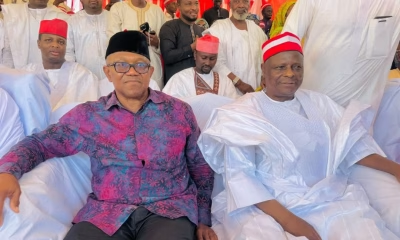
2027: Obi, Kwankwaso Supporters Launch ‘OK Movement’ Ahead of ADC Presidential Primary
-

 Events4 weeks ago
Emiralty Africa to Host ‘Emiralty Connect 1.0’ Summit in Lagos